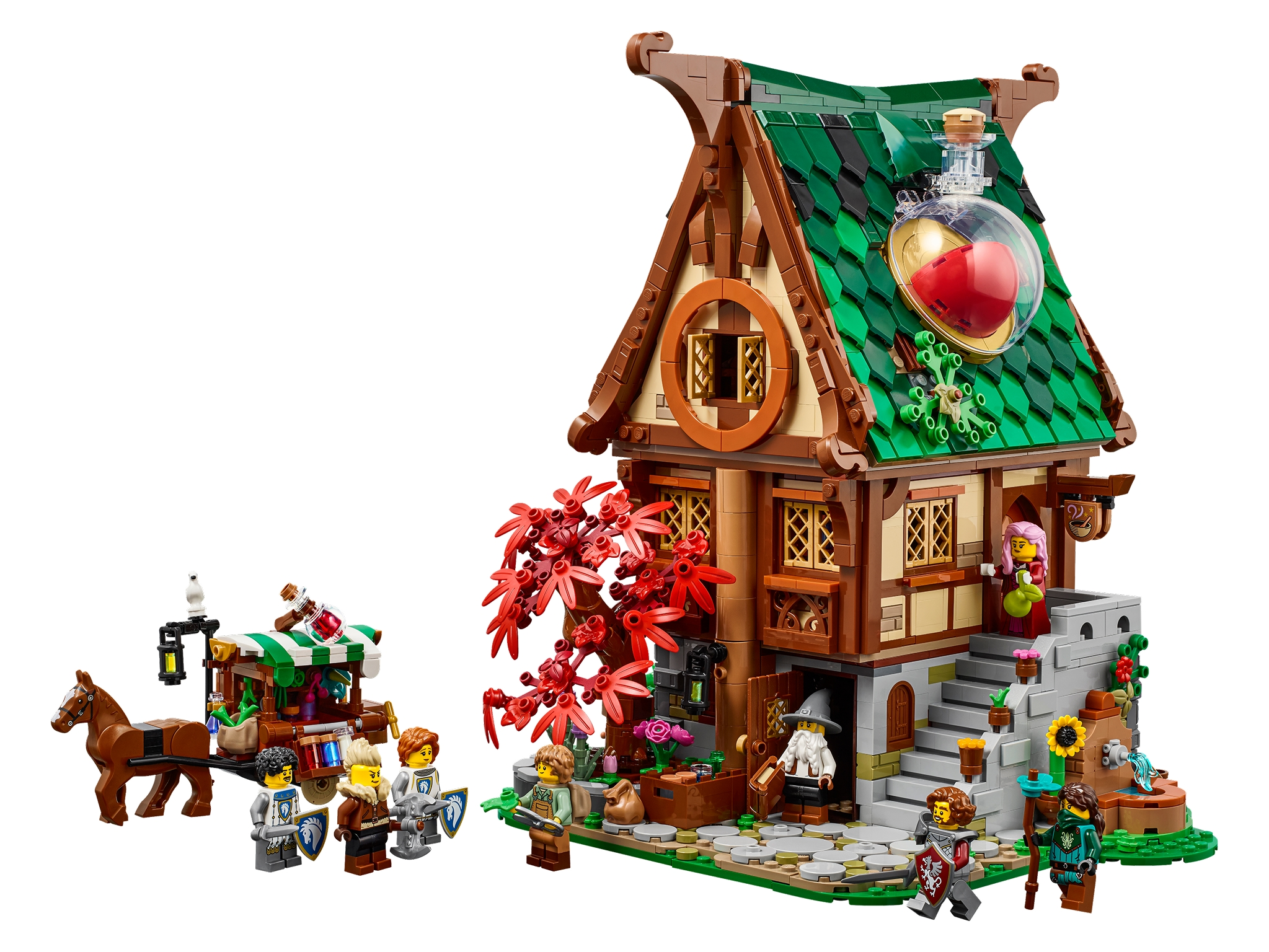
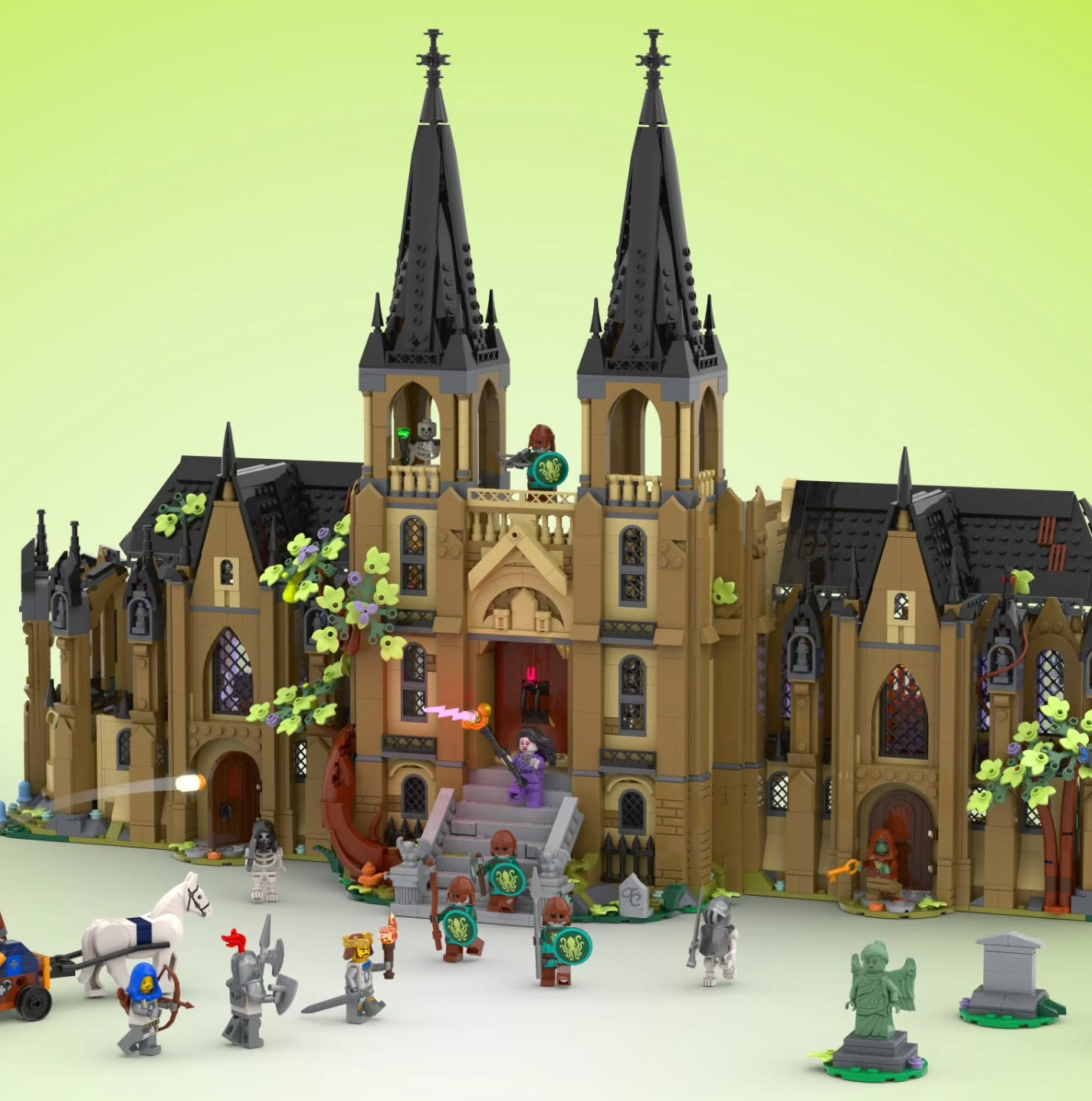
The Bricklink Designer Program features LEGO sets designed by fans, voted on by fans. Unlike LEGO Ideas, these sets aren’t reimagined by in-house LEGO staff, so when you build the set, you experience exactly what the designer dreamt up, professionally packaged by LEGO. Crowdfunding for Series 7 opens on February 16th. One set you can pre-order is the Alchemist’s Shop, a 2,319-piece Castle creation that’s a spiritual successor to the beloved Medieval Blacksmith set. I had the pleasure of building an early copy, and the set is a wonderful building experience packed with magical details, clever techniques, and a great display presence. Even better, we had the chance to chat with the set’s designer, Sean Wallace, about how the set went from idea to reality.
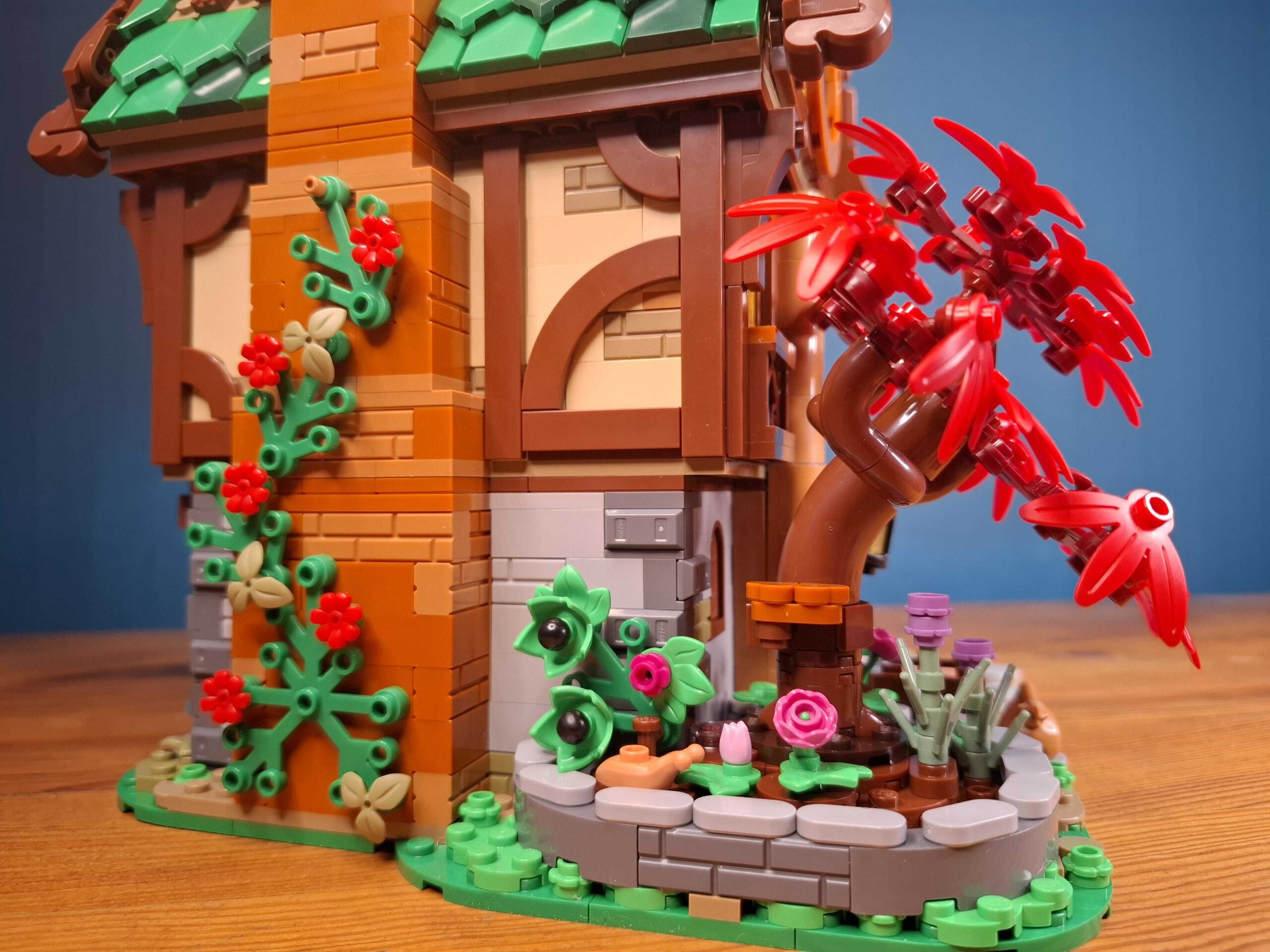
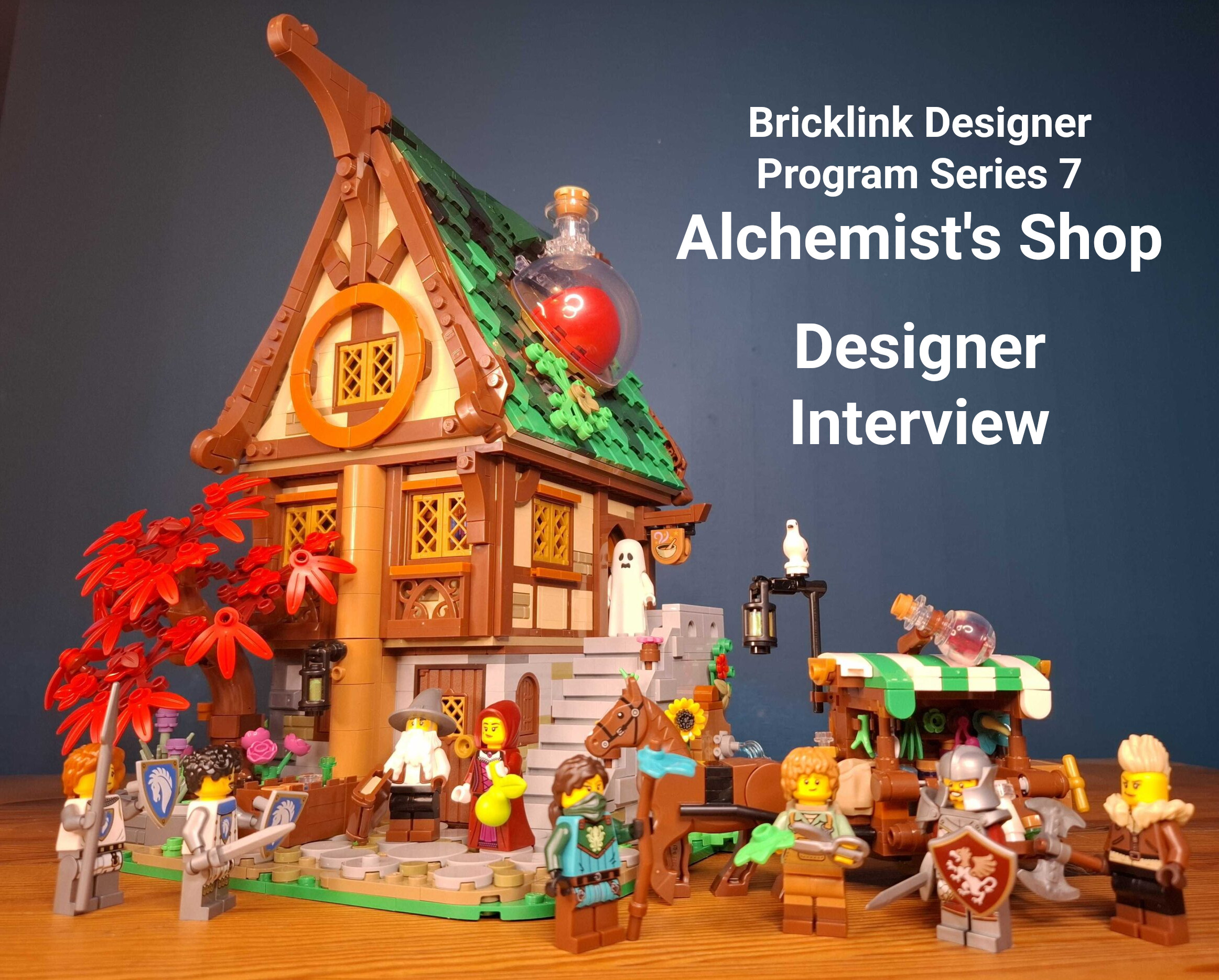
TBB: First of all, congratulations on the upcoming release of the Alchemist’s Shop. To have your creation produced and sold as a set must be a dream come true.
Sean Wallace: Thanks so much! It absolutely has been, and I’m very grateful to have been chosen among many other talented finalists. Collaborating with LEGO to design stickers, add minifigures, add newly released parts, and to see so many fans excited for it has been incredibly rewarding.
TBB: With Castle sets from LEGO infrequent at best, BLDP has become the premier source for sets that build on the legacy of Classic Castle. What is your relationship to LEGO Castle? What was your first Castle set? Your all-time favorite set?
SW: My earliest was King’s Siege Tower which felt incomplete without a castle to siege, but my next set, Blacksmith Attack, I have fond memories of. It was a small set, but packed a variety of fun parts and a unique function for its size. In 2021, when the Medieval Blacksmith was released, I had finally found a LEGO Castle set that encapsulated what I needed from the theme. It combines the textures and materials from medieval architecture with the playful LEGO colour palette to create something that feels truly complete to me. From there, I’ve gotten a hold of the Lion Knight’s Castle, one of the greatest LEGO sets I’ve ever built. Then, the Red Dragon’s Tale, which inspired the flavour of fantasy I’ve included in The Alchemist’s Shop.
TBB: Outside of LEGO, are you a fan of knights, magic, and medieval times? What draws you to those sorts of stories and settings?
SW: I love medieval fantasy, and have been playing D&D since high school! I recently was Dungeon Master to my first one-shot campaign in which we used the LEGO D&D set, and I even managed to incorporate LEGO’s provided sound effects and ambient music. Medieval fantasy games have also been a huge inspiration of mine, and there are so many great ones coming out now. With The Witcher 3, Dark Souls, and Baldur’s gate 3, I’ve been absolutely spoiled with rich and exciting fantasy worlds. The thing that keeps drawing me back to this genre could partly be the environments and architecture. Whether it’s a pointed arch of stone or a timber frame, the weight and structure of buildings are visible in their design. This makes them appealing to look at and fun to design in my opinion!
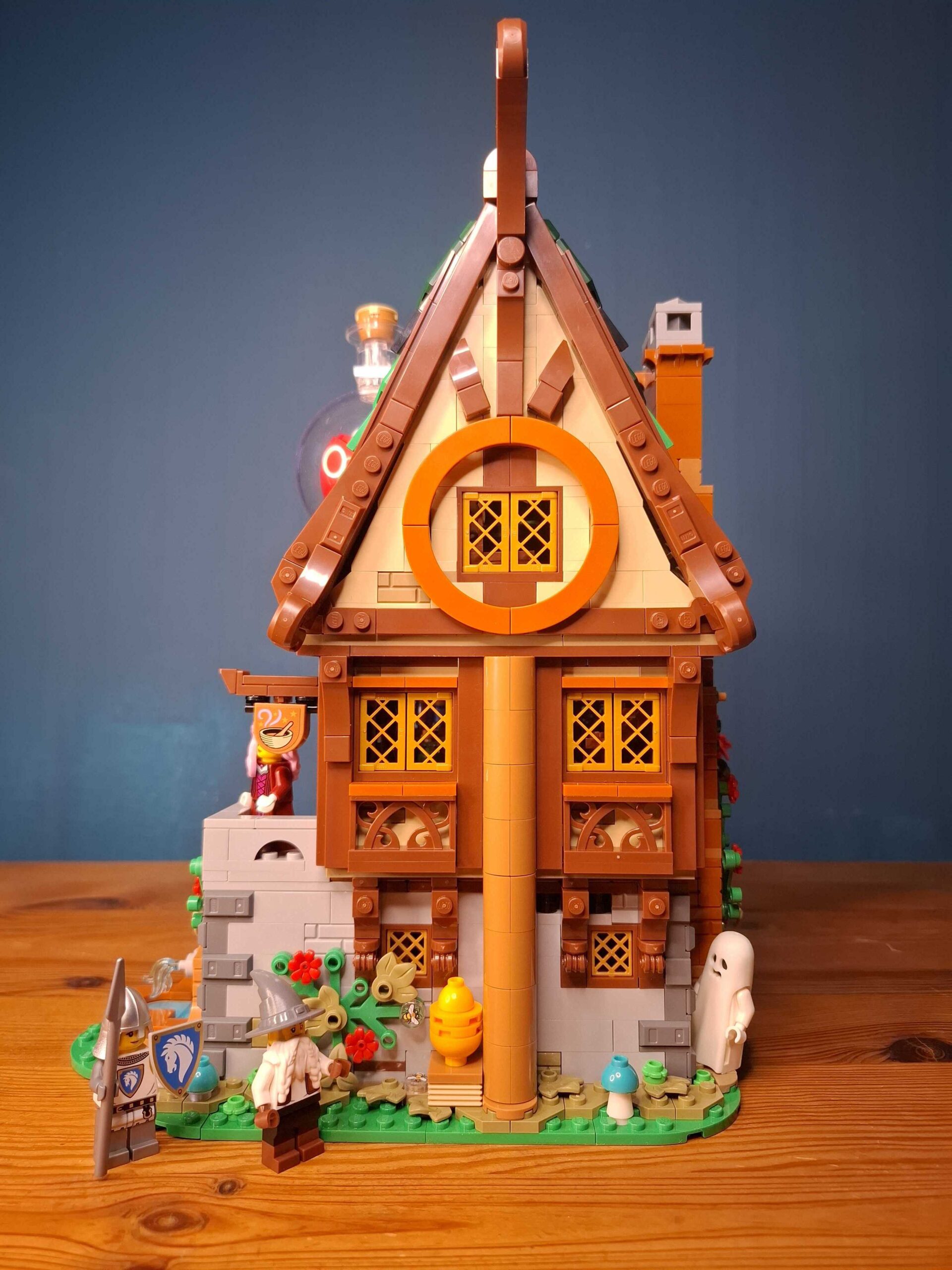
TBB: How did you land on Alchemy as the focus for your shop?
WS: I knew I wanted to create a new addition for a medieval village, but there were a few things that made me pick alchemy in particular. One was that it allowed me to incorporate some of my favourite LEGO parts: transparent parts, plant parts, and the official LEGO flask pieces (which luckily were available for the final design!). It also just felt very exciting as a concept to me, inspired by real historical alchemy, which feels just as magical and wondrous.
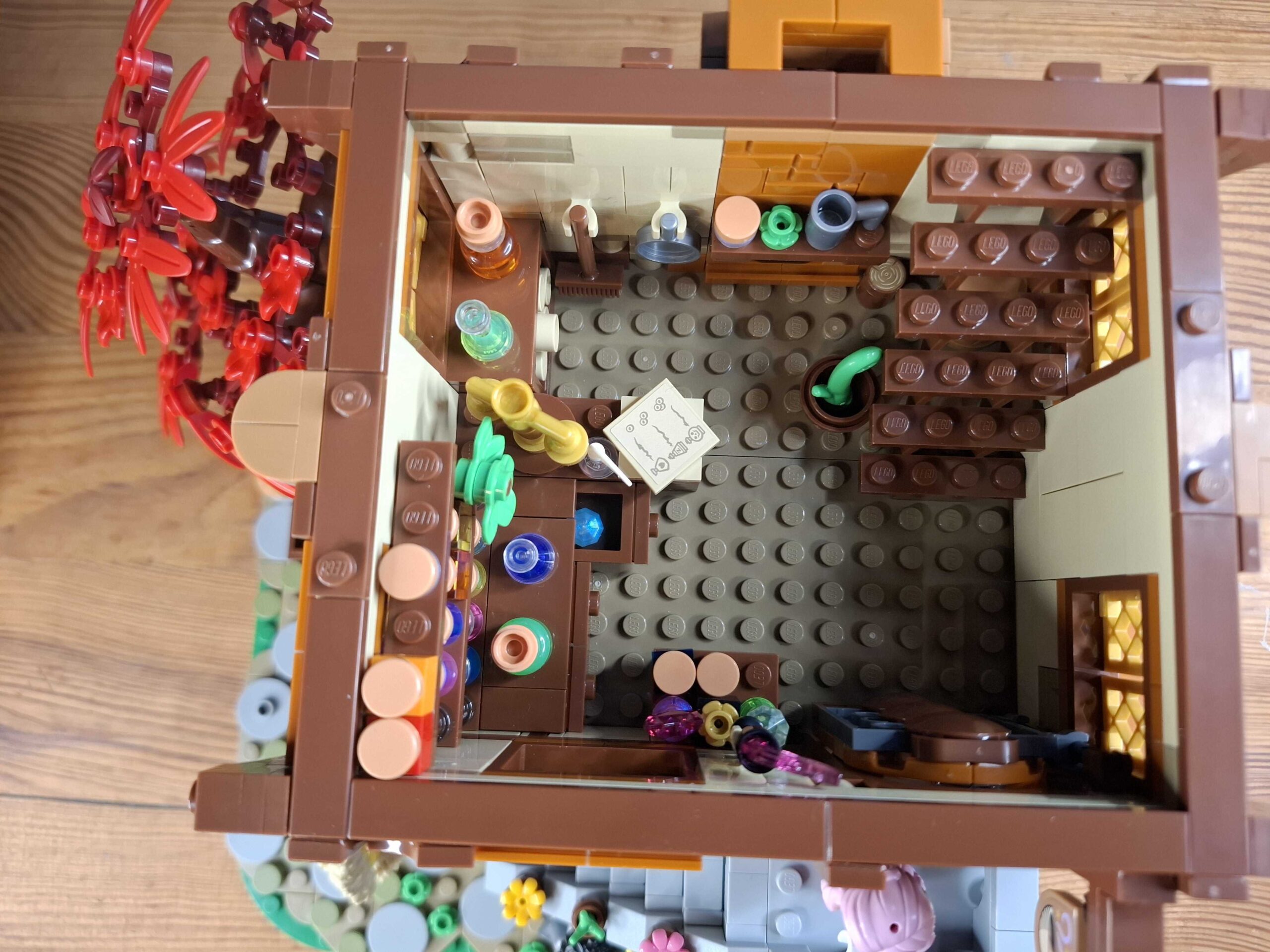
TBB: The showstopping feature of your model is the incredible potion bottle on the roof. It’s such a brilliant design, so eye-catching and distinct. What was the biggest challenge about integrating a clear bottle into the architecture? How many iterations did the concept go through before you landed on the final design?
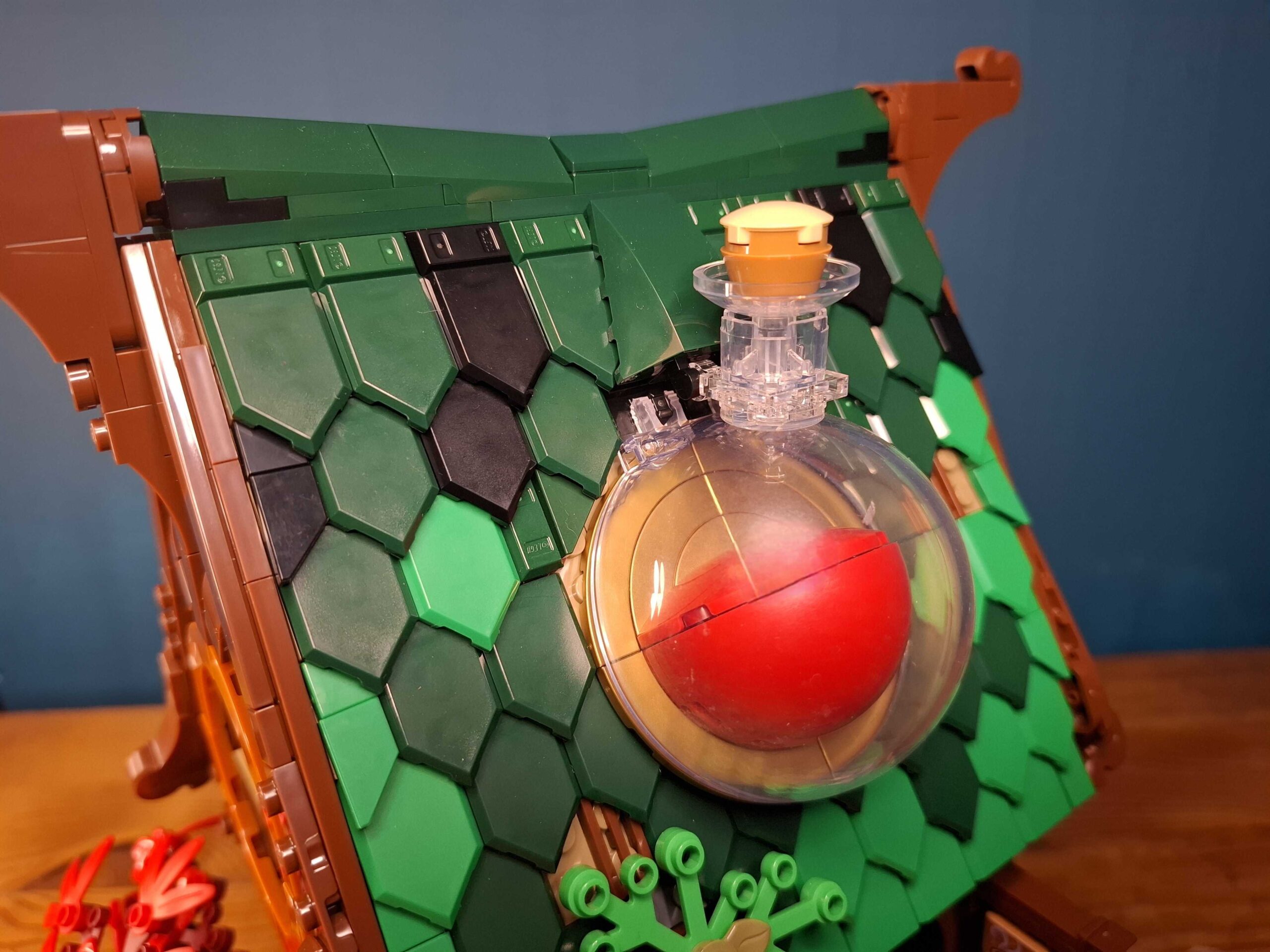
SW: One of the earliest ideas I had for the design was a traditional apothecary with a vintage sign, but I felt the need to make this set stand out, which is where the potion bottle design came in.
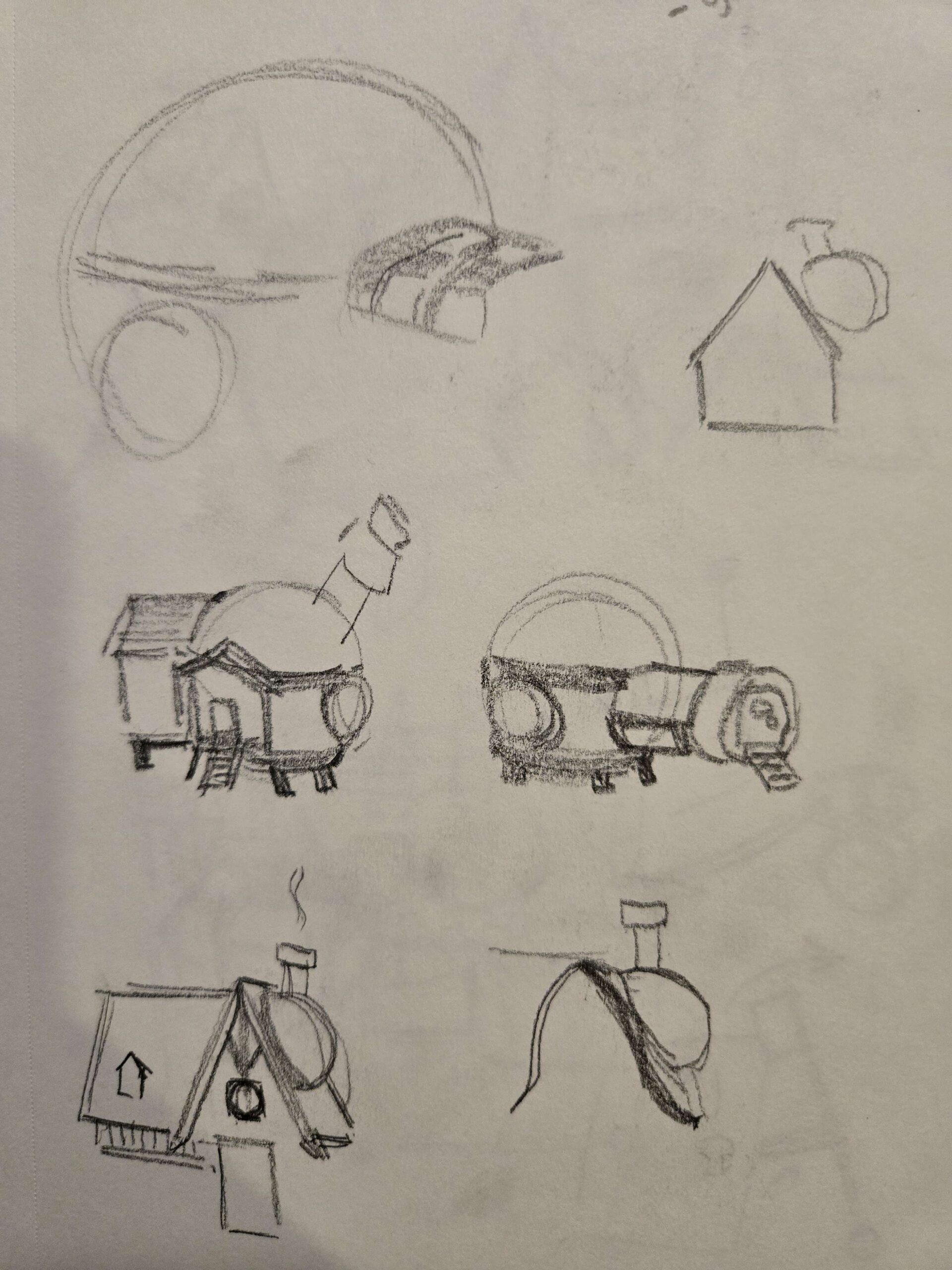
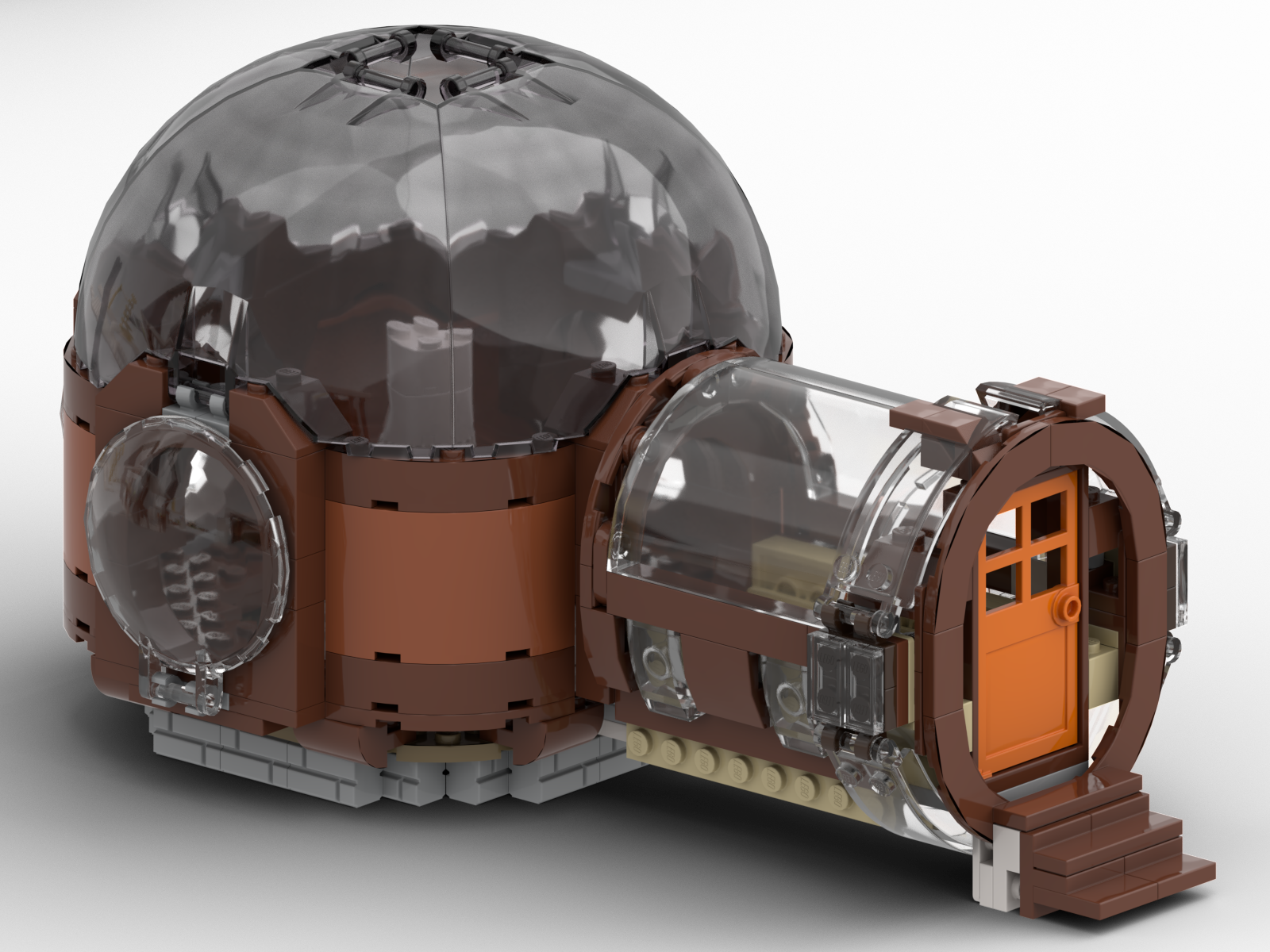
I experimented with designs where the entire building was one giant potion bottle, but it became too challenging with the limited transparent parts available in the palette.
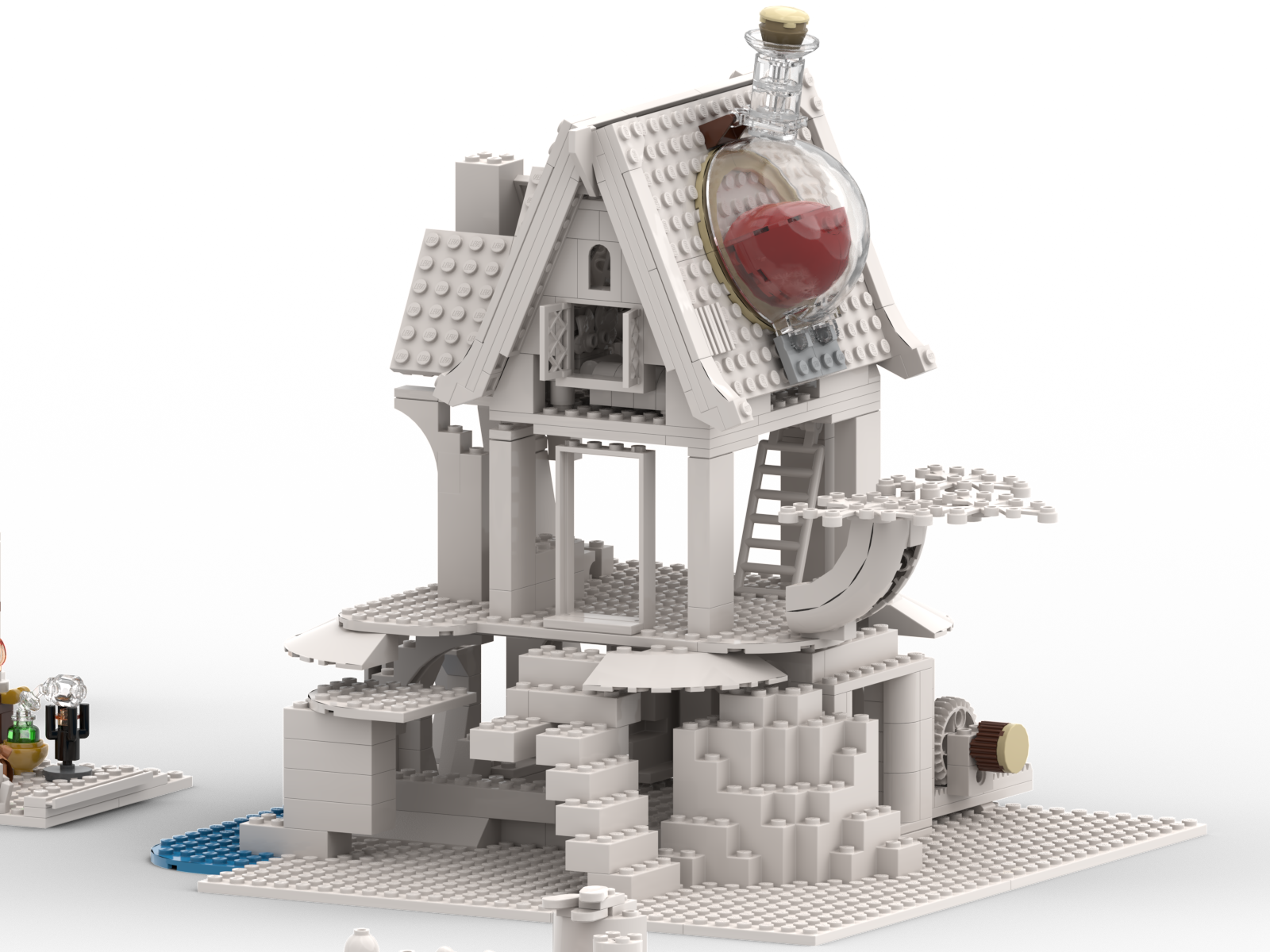
In another design, I combined it with the chimney but I felt that muddied the design too much.
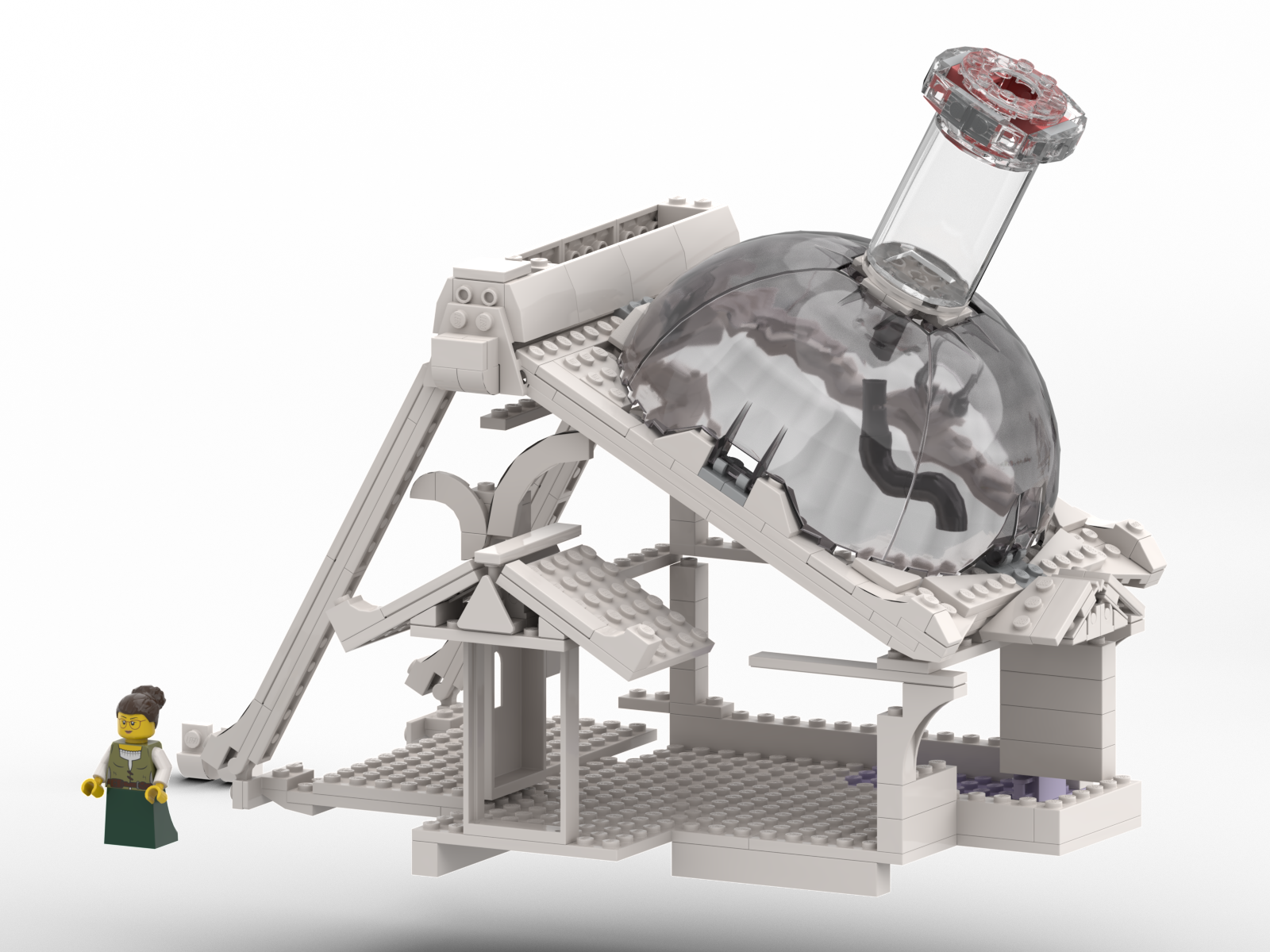
It took a couple of days before I discovered the current design with the 8×8 dome piece, but once I did it stuck through every other iteration of the model and I was able to build the rest of the design around it.
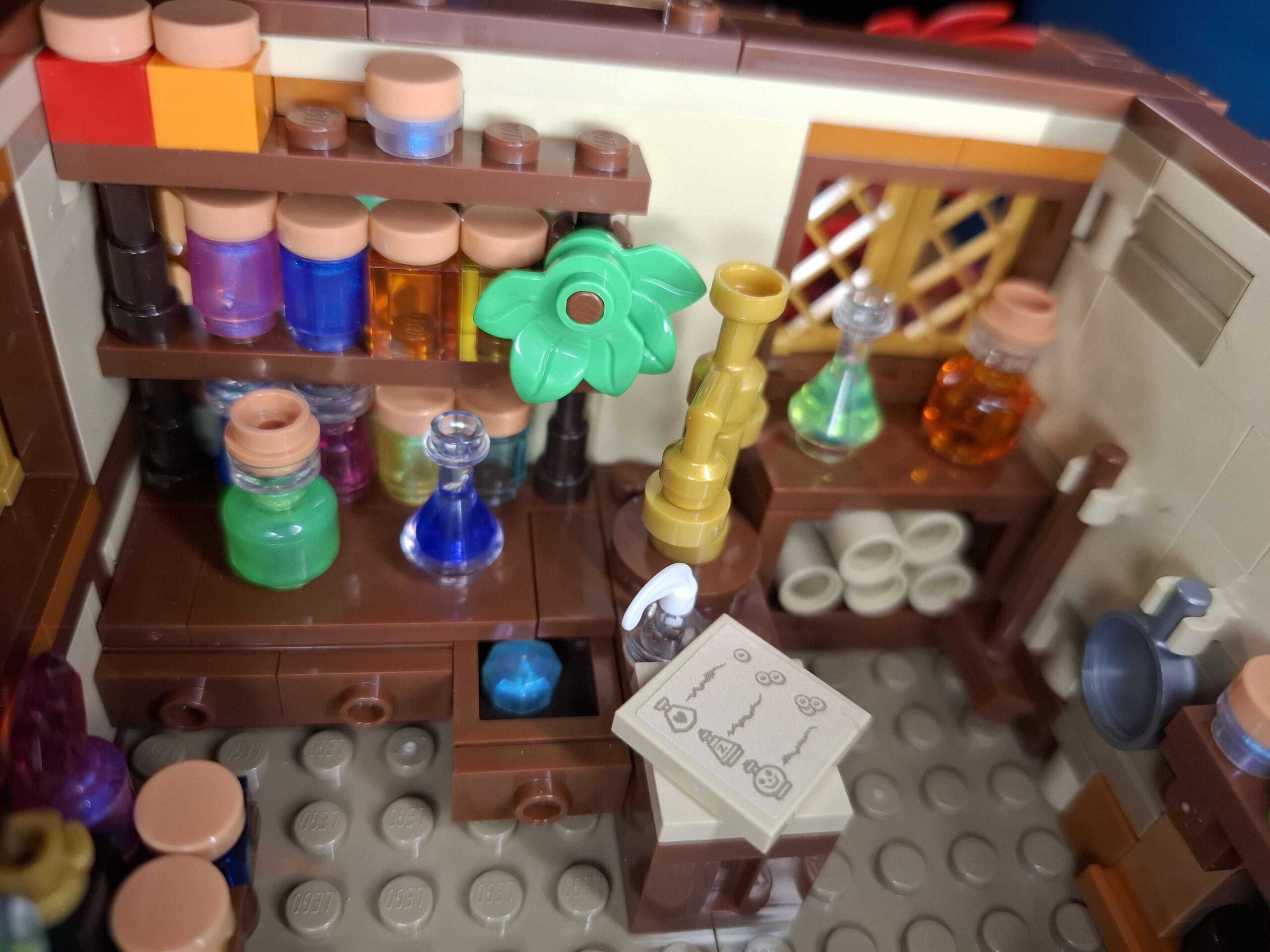
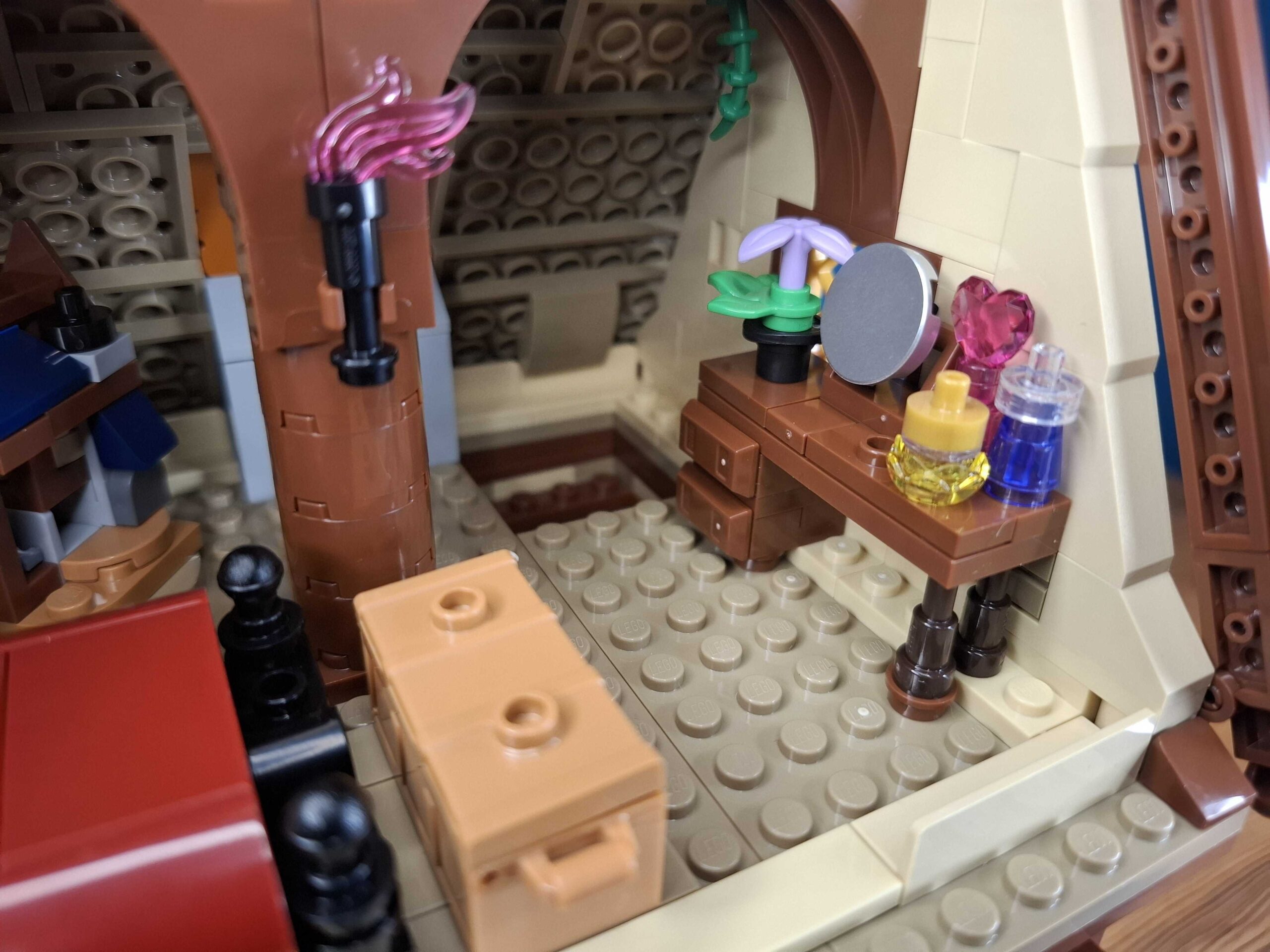
TBB: The model is filled with herbs, potions, and trinkets with potent potential, both inside the shop and out. It must have been fun to come up with so many curios and magical objects. Do you have any favorite details?
SW: I’m pretty happy with the green alembic on the alchemist’s worktable, another build that stayed unchanged throughout the design process.
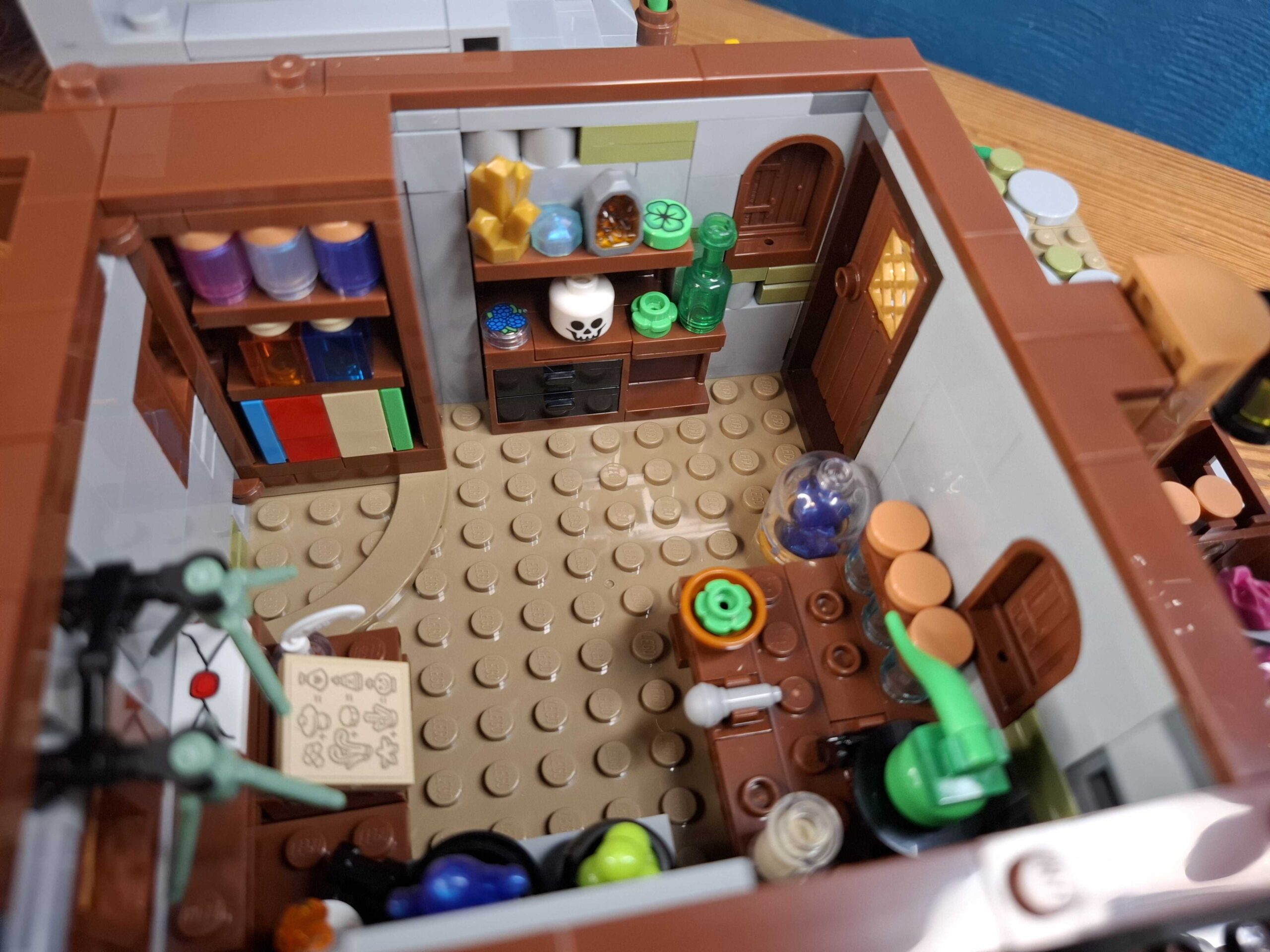
There’s also the book inside the hidden compartment that contains the recipe to the philosopher’s stone, a nod to real medieval alchemy. Lastly, I’m a big sucker for the new satin-transparent parts and glow-in-the-dark parts! They fit so well with this magical environment that I had to include them.
TBB: Previous BLDP castle sets have been more overtly connected to established factions like the Foresters, Black Falcons, or Wolf Pack. How do you see the set connecting to the familiar Castle theme? Where did you take inspiration from LEGO’s castle history?
SW: To be honest, I was a little hesitant to tie the set too closely with any particular faction in the event that the minifigure selection would phase out (which they did!). I think this design best serves as an extension of Majisto the Wizard’s role in the LEGO Castle theme. He appeared in the Lion Knight’s Castle set with a potion, but even with his workshop I felt like there was some untapped potential.
TBB: Aspects of the build, especially the roof design and general proportions, echo the Medieval Blacksmith set. How did you balance inspiration with imitation? Were you ever concerned fans might find aspects too similar?
SW: This was the biggest challenge for me and required a lot of reflection to decide what to cut and what to keep. I wanted enough space for the interior to fit at least the lab and shop, but I didn’t want to put either of those rooms in the attic, and I also didn’t want this set’s footprint much larger than the Medieval Blacksmith, which meant that I had to make this set 3 floors.
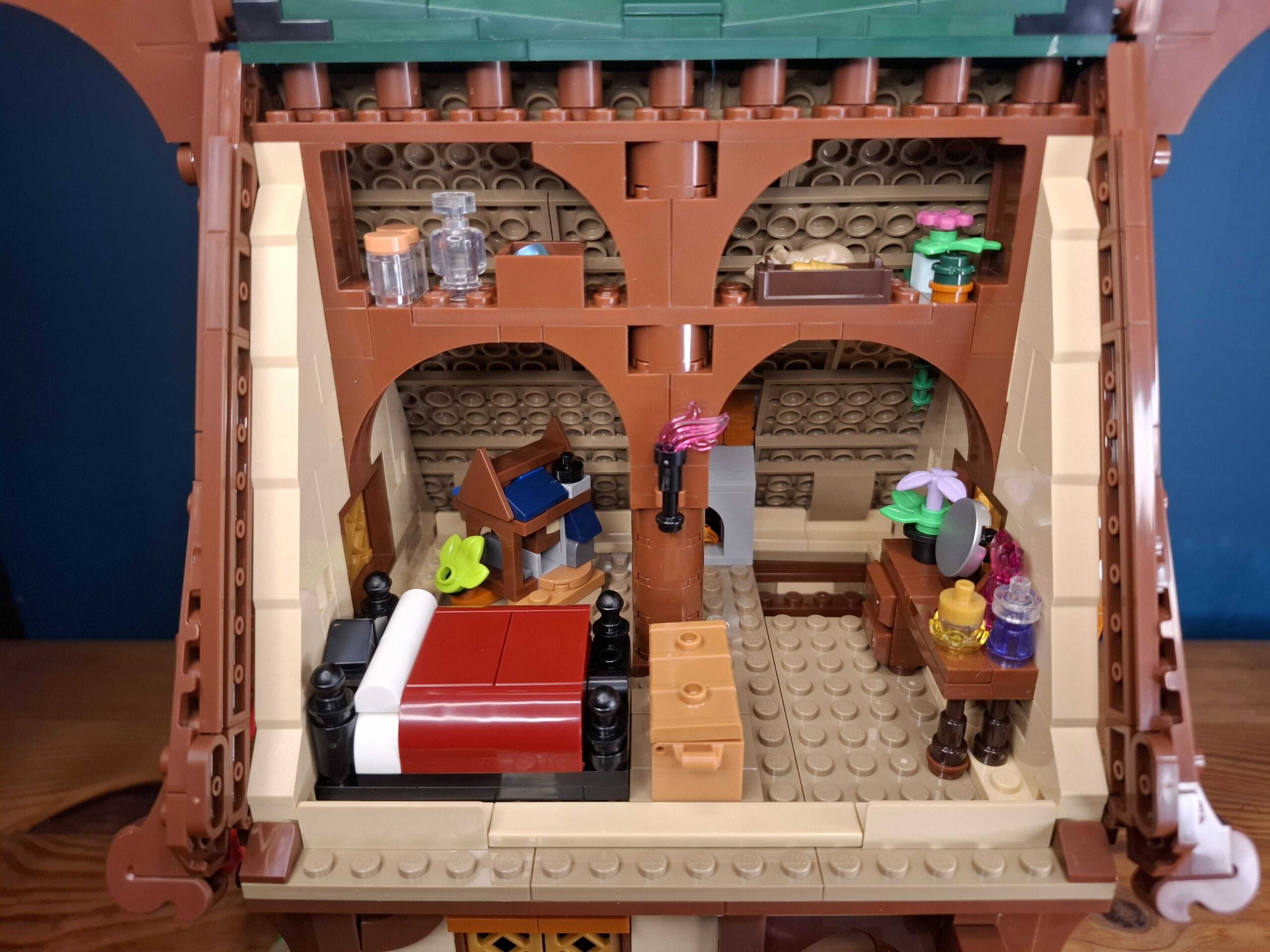
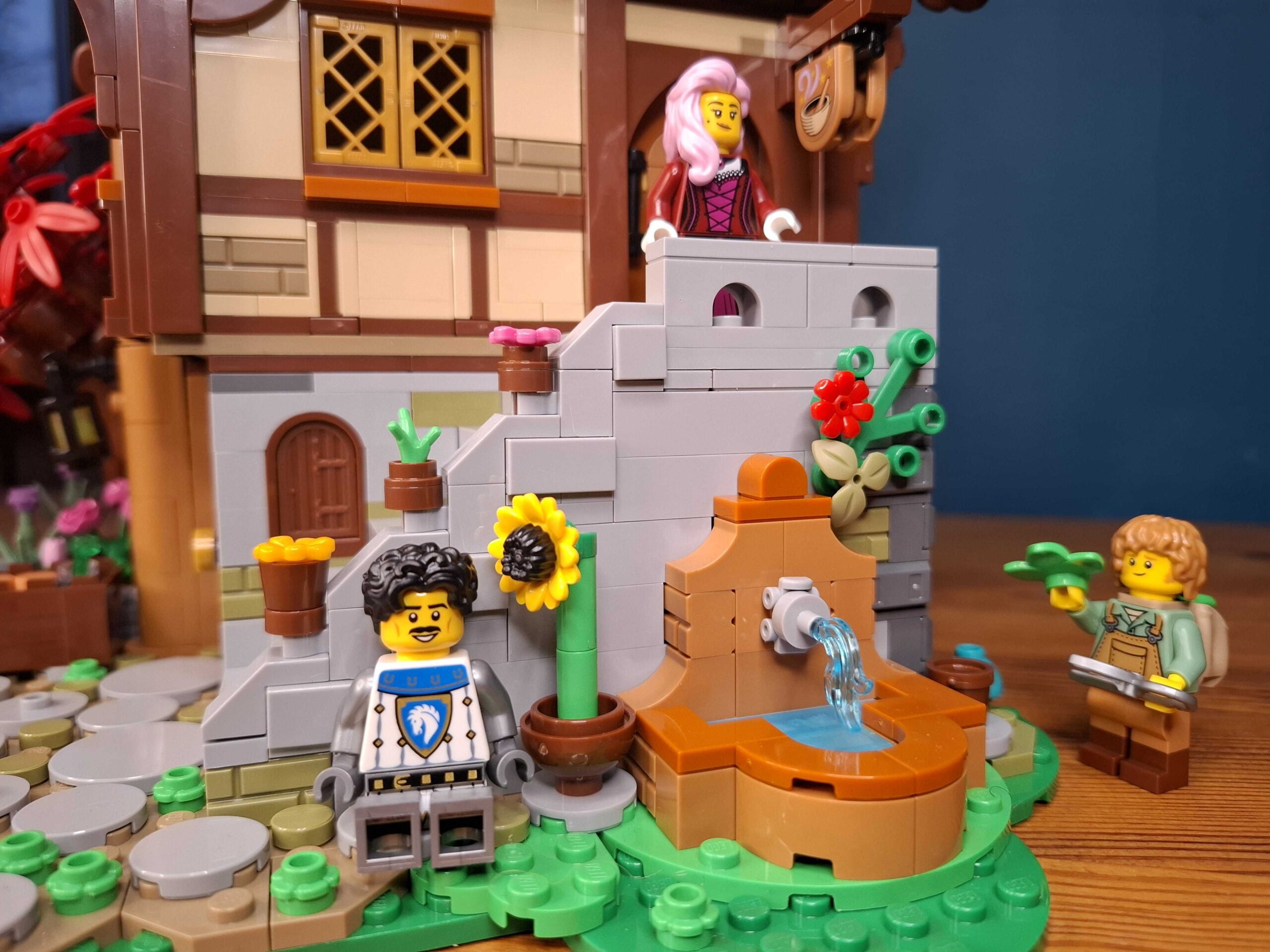
I was concerned the exterior stairs would look too similar to the Blacksmith Shop, but I was even more worried that adding them to the interior would fill up too much space and bulk up the building. So it really was just a constant balancing act that I had to juggle throughout the design process, but I think I landed on a final build that hopefully proves to be a fresh and new build experience for fans!
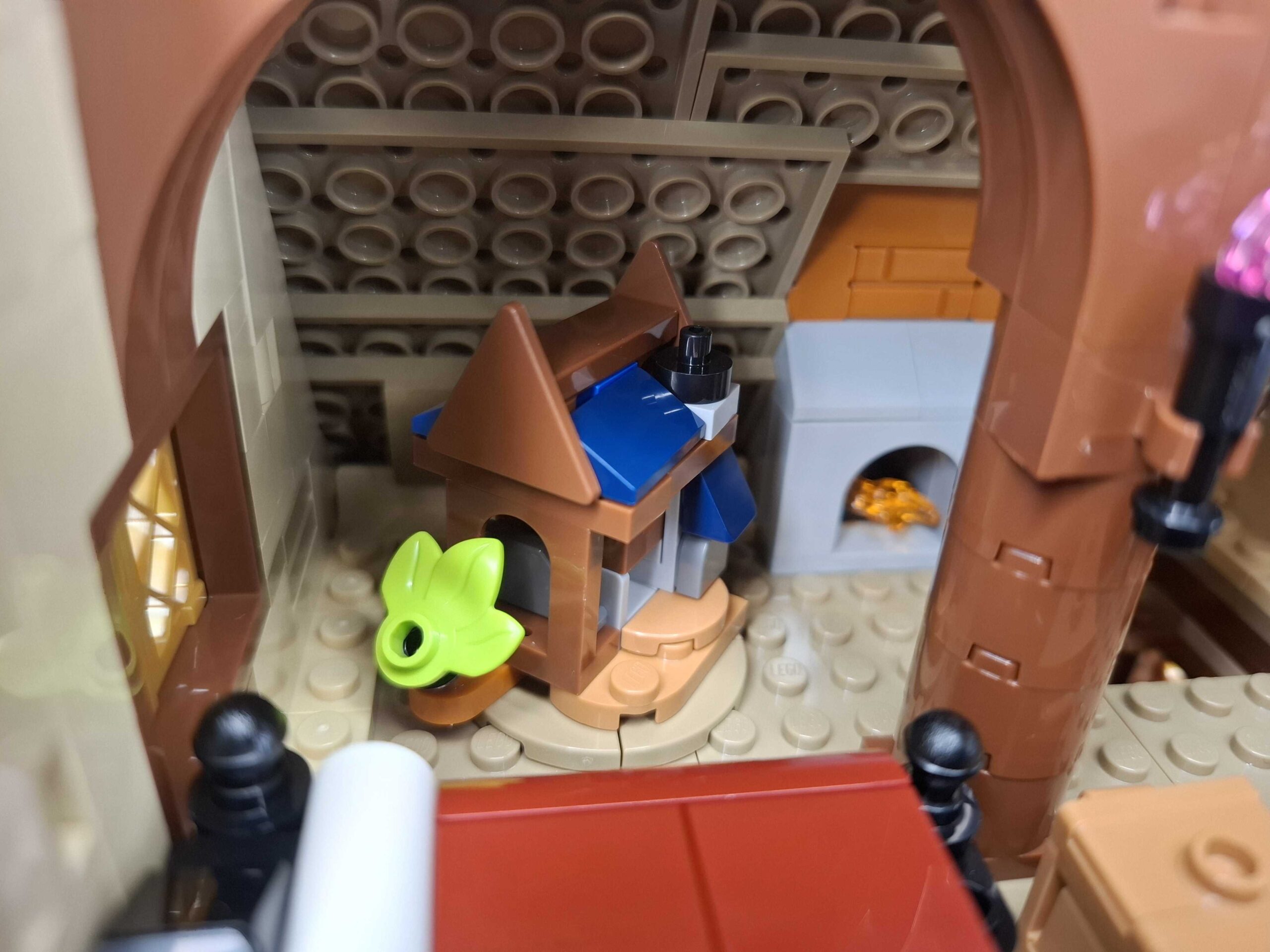
TBB: There’s a surprising easter egg for Castle fans in the top floor in the form of a microscale Blacksmith. How did that detail come into being?
SW: This was an addition from after the set became a finalist. I felt it was an appropriate homage to the set, and it’s one of my favourite details! It nears the end of the build as a sort of cherry on top. A perfect combination of parts, I’d find it hard to come up with a better design for it.
TBB: This is your first set with the BLDP, and while you have a few mocs up on rebrickable, the Alchemist’s Shop is orders of magnitude more complicated. How long did it take you to get your idea to the place where it felt ready to submit to the platform? What were the biggest challenges getting the concept approved for voting?
SW: You wouldn’t believe it, the entire design and build for the Alchemist’s Shop was only about a month! A single month with only this set on my mind, I spent hours every day either planning, coming up with ideas, or playing with parts in Studio. While I probably won’t rush myself that intensely again, engulfing myself in this design really helped with the creative process and I think I was able to tap into something really special. Getting this model to a place where I felt confident to submit required me to be my own worst critic and try to hash out its biggest issues. Steering it away from a Medieval Blacksmith lookalike, balancing symmetry and asymmetry, and carving it down to its bare essentials were all necessary to make this set a worthy finalist.
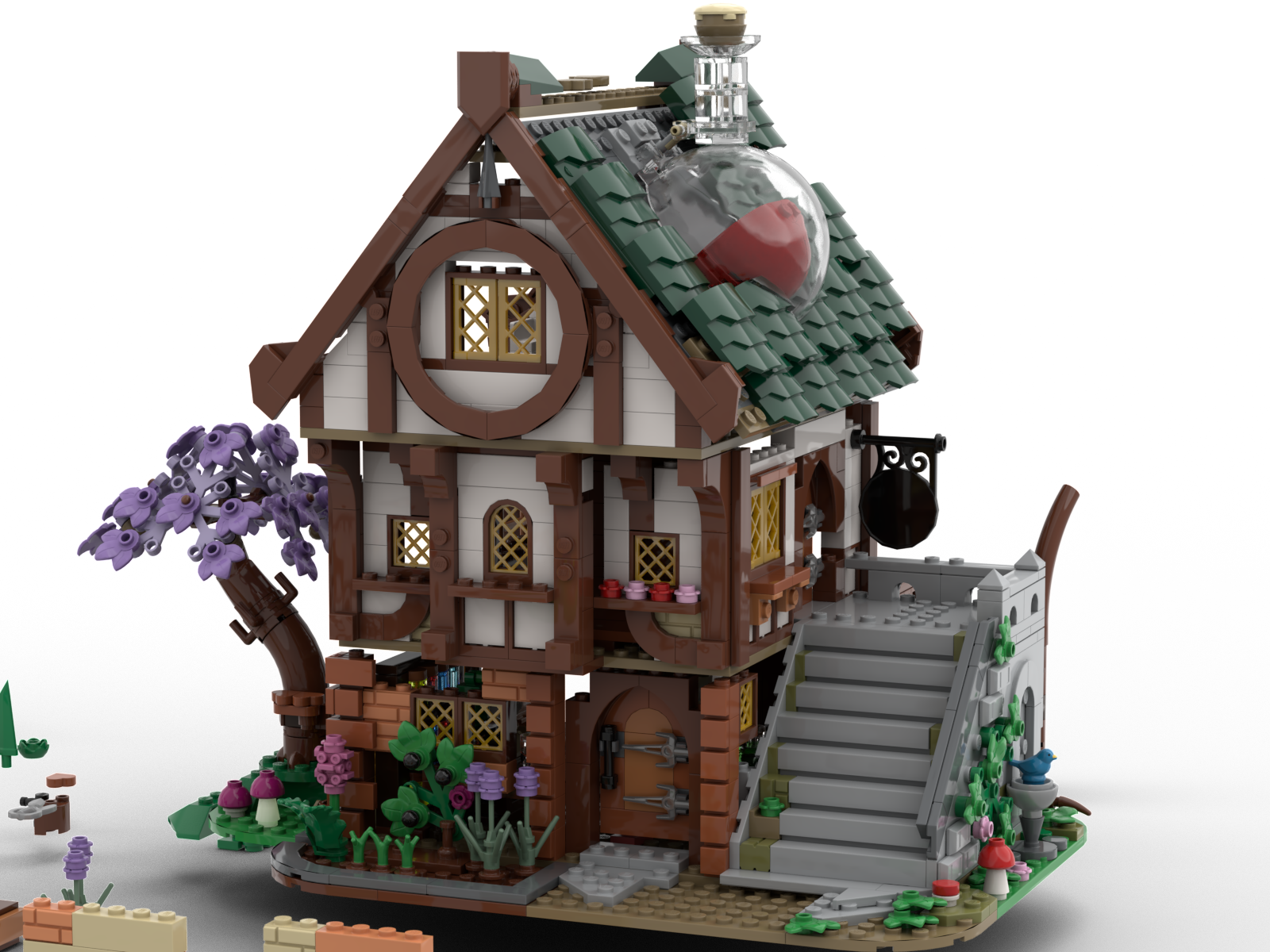
TBB: Have you worked with Studio for long? How does digital building factor into your building process? Do you usually start with digital models or physical bricks?
SW: I’ve been working with Studio for a few years, but designing a model of this size was new to me and a huge undertaking. I usually start out digitally just to get key parts together in a big messy pile, and just start playing. I’ll combine elements to try and find usable ideas, sketching it out every so often. I try to find a balance of letting the pieces define the design, but also letting the design define the pieces.
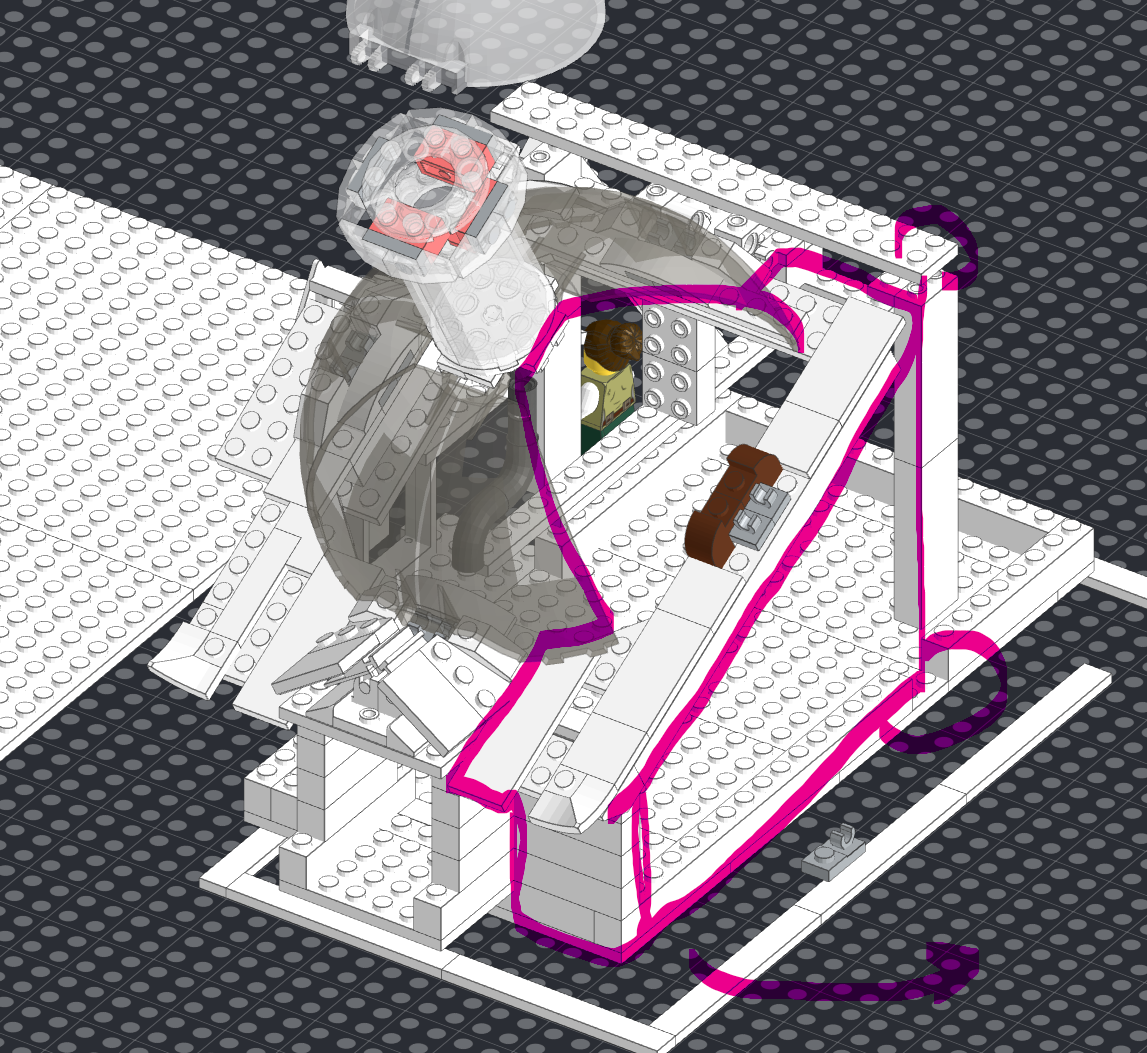
TBB: Were there aspects of the build that you needed to work out with physical bricks, or could most of the engineering be solved digitally?
SW: The majority of it was solved digitally, but the roof was different and required a lot of testing with physical bricks. It was challenging coming up with a sturdy design that left minimal gaps, especially with the stepped tile pattern on top. Getting the studs to line up in multiple different areas at the same time was like trying to capture the sun and moon in the same picture, and it took a lot of tries to get it right. The alchemy cart was also a physical build for the folding shelf feature, and needed work to trim down the bulk while keeping it functional.
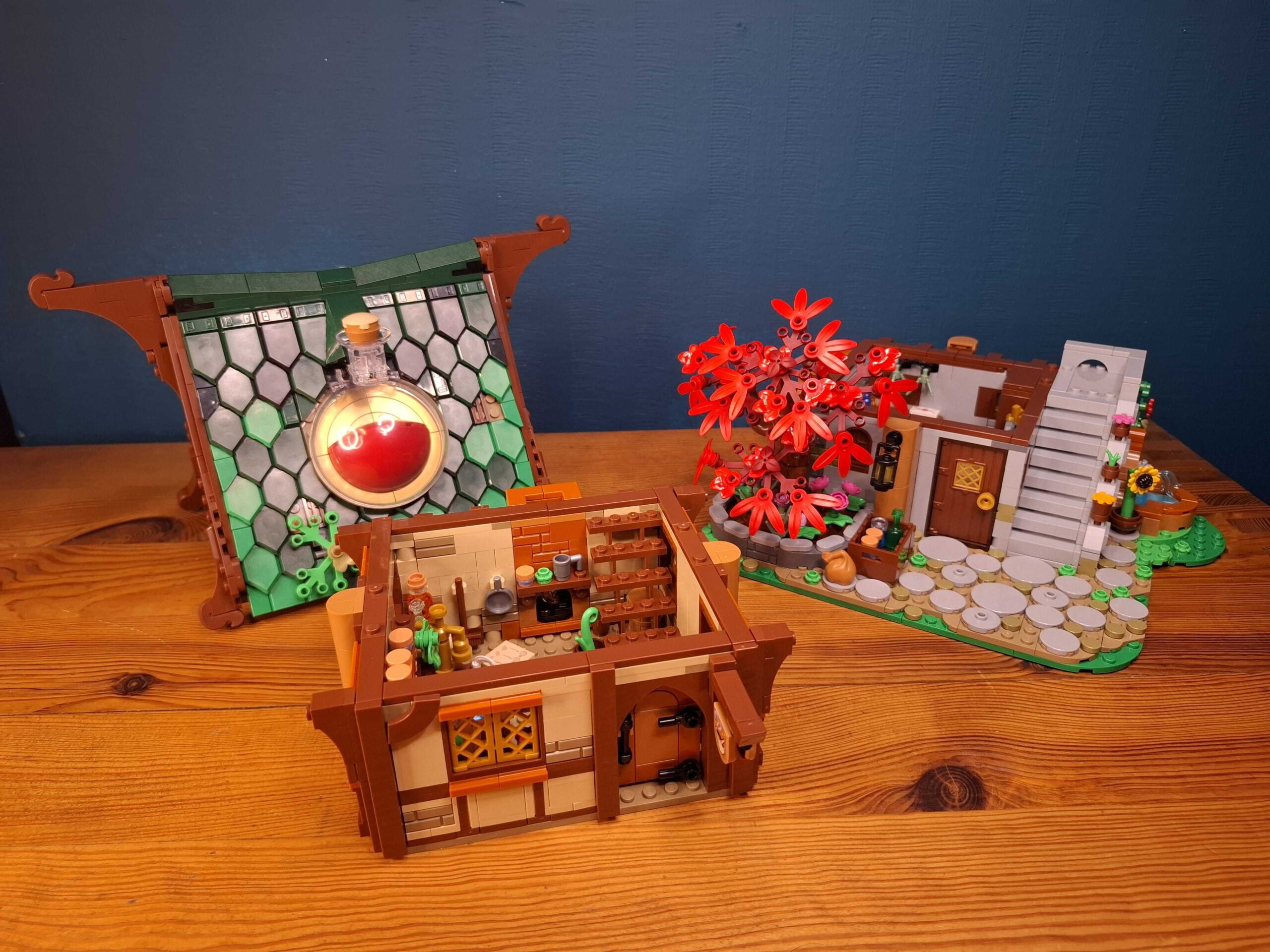
TBB: Were there any builders in particular who inspired your work or helped mentor you in the process of designing a set of this scale?
SW: Wes Talbott’s Medieval Blacksmith is the first that comes to mind and was no doubt one of the most influential sets, but another major source of inspiration was actually Jonas Kramm’s Mushroom House from an earlier BDP series. It really pushed me to make my own design iconic, unique, and creative with parts. Outside of that, I referenced a ton of instructions online to come up with techniques for this set.
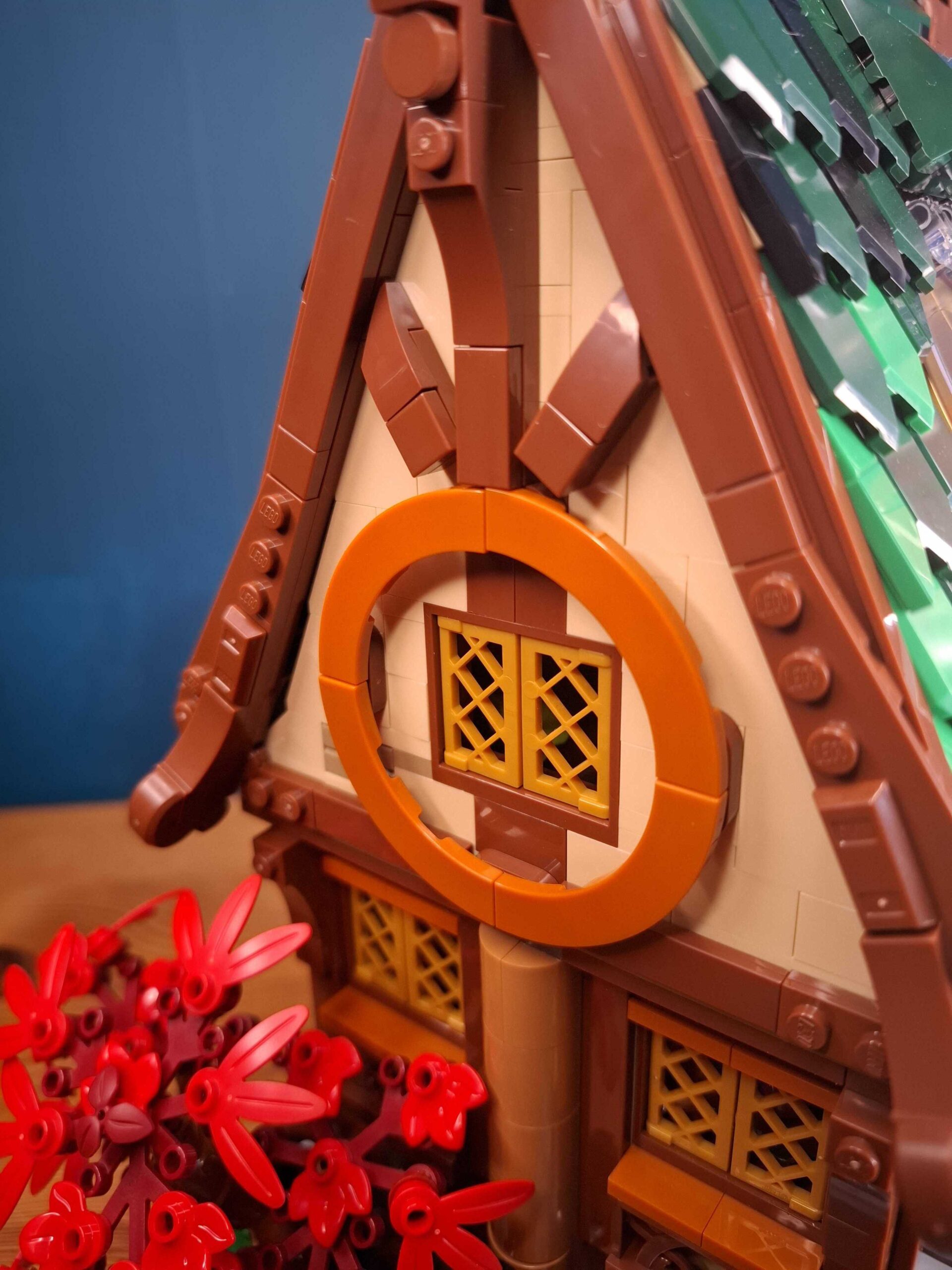
TBB: Building the set, I was impressed by the innovative techniques that felt like they could have come straight from an Icons Modular. For example, the way you built the stairs using SNOT and modified 1×2 bricks with channels is so elegant and clever. What technique were you most proud of?
SW: There’s a brick-built scale in the shop using 5 parts that I was very proud of, and was one of the first designs I came up with for this set! It’s simple, but I love small builds that are instantly recognizable.
TBB: Most LEGO fans are quite familiar with the Ideas program and how fan designs can become official sets. The BLDP has a number of differences, one of which is that, unlike Ideas sets, the approved projects don’t undergo a redesign by LEGO staff. Could you talk about what the review process entails to get from your set ready for production?
SW: Working with LEGO on this set, there were several revisions to improve its structure and remove illegal techniques. Outside of that, they’re pretty hands-off when it comes to creative decisions around the model. They’ll recommend newly moulded parts like the snail and pear for example, but it’s up to you if they get included and how they do. There were a couple of changes that I made myself to streamline the roof’s colours, open up more space for the interior, and polish up interior decorations.
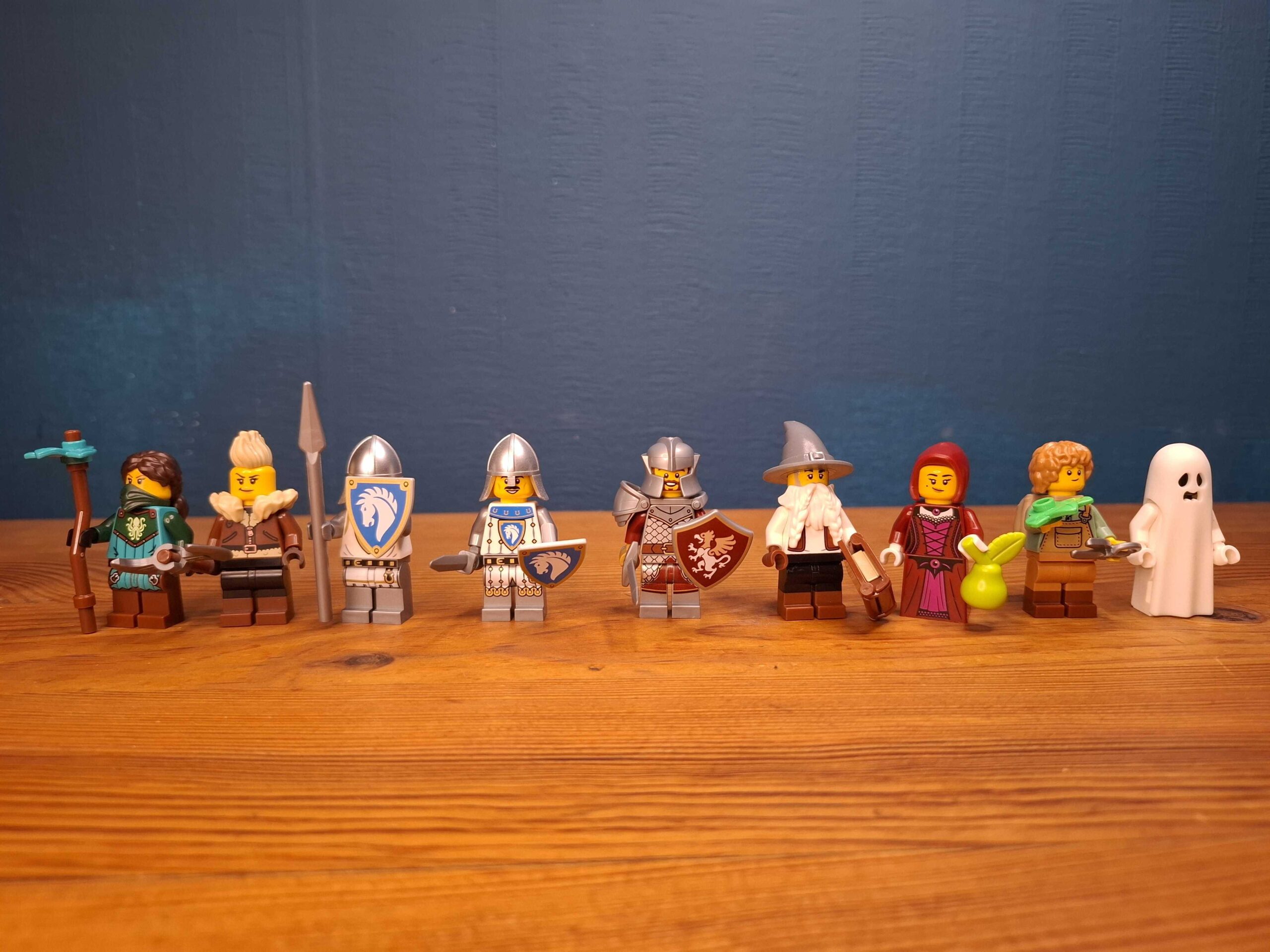
TBB: Your timing was fortunate with regards to minifigure options, as LEGO had just introduced several new factions in 2025 – Kraken, Griffon Knights, and Horse factions all appear in the Alchemist set. That must have been exciting! How did you decide on the factions that are included?
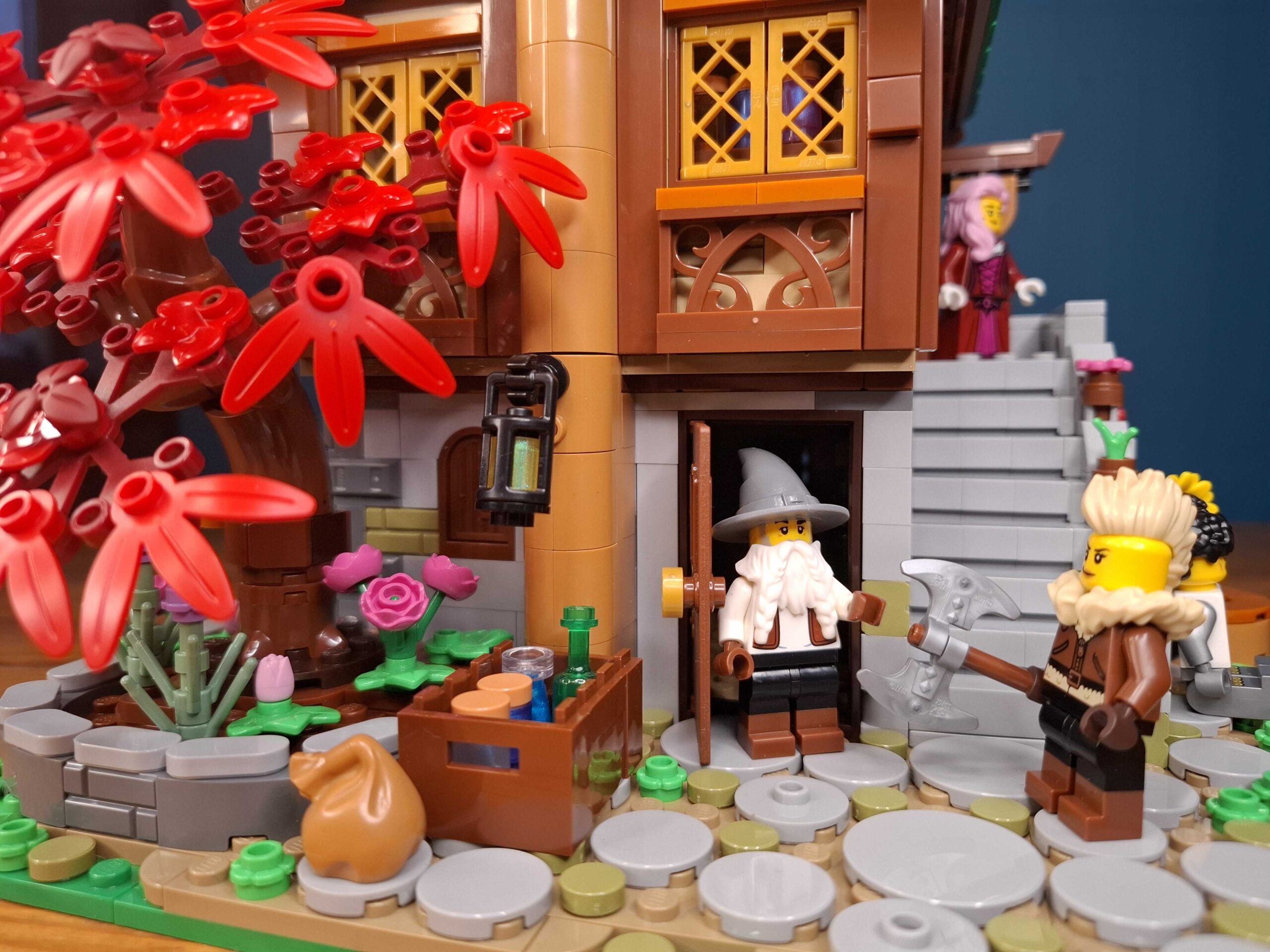
SW: It was such a treat to see these parts ahead of time! I was so surprised to get 9 figures, but that meant that I could include nearly all the new castle factions here. We wanted to have a good variety of alchemist shop residents, as well as visitors. Outside of these factions the torso options were rather limited, so we ended up with a zipper on one of the torsos. Not my first choice, but I think we still got really lucky with the selection of parts overall!
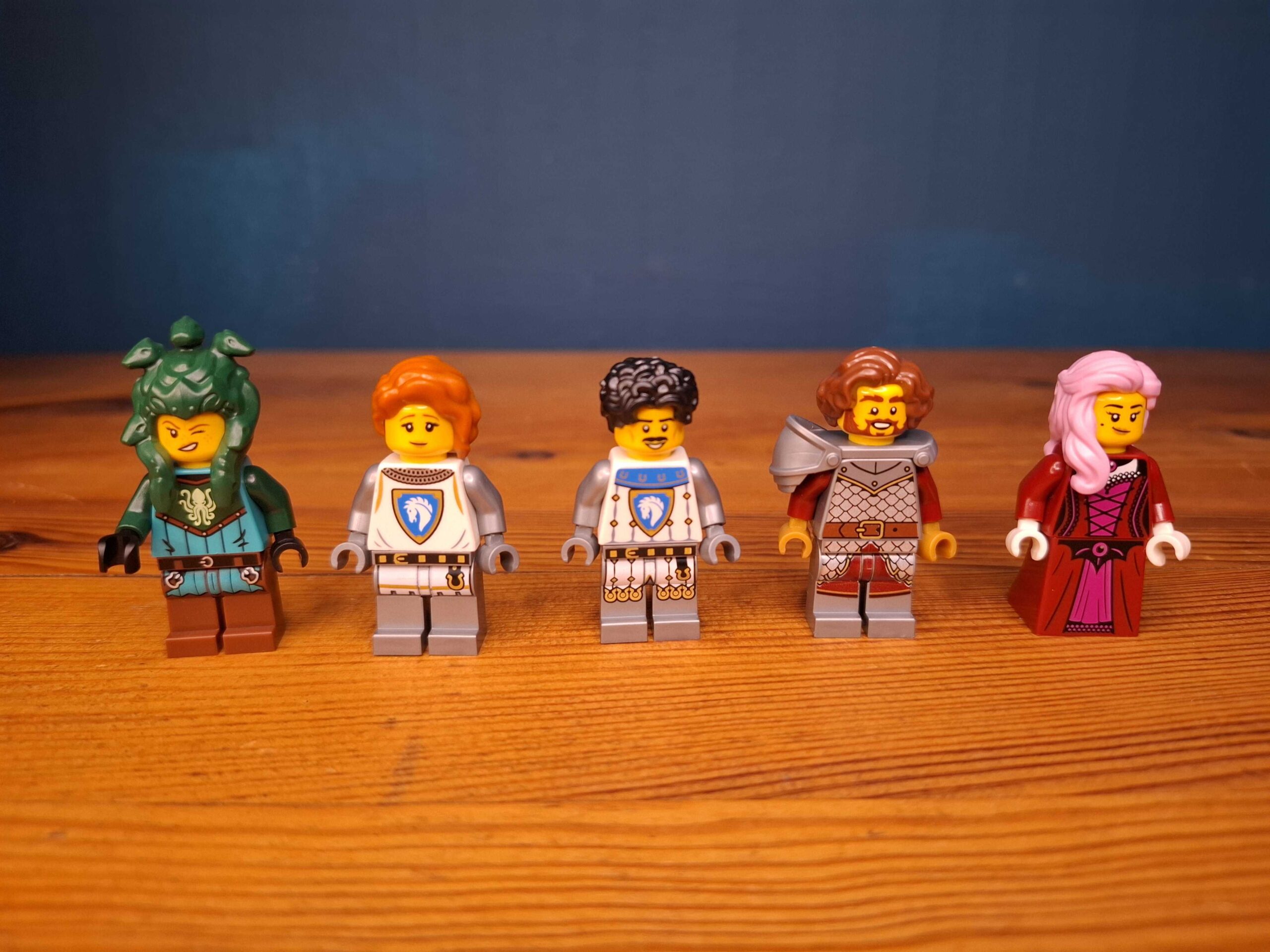
TBB: Unusual for a castle set, many of your figures have alternate headgear, including a snake hairpiece for the Kraken faction character. Was this something you pushed for?
SW: The snake hairpiece was actually Alex’s idea! The idea is that she’s afflicted with some kind of curse or illness, and she needs the aid of an alchemist to cure her. It’s a clever use of a new part, and a great example of visual storytelling.
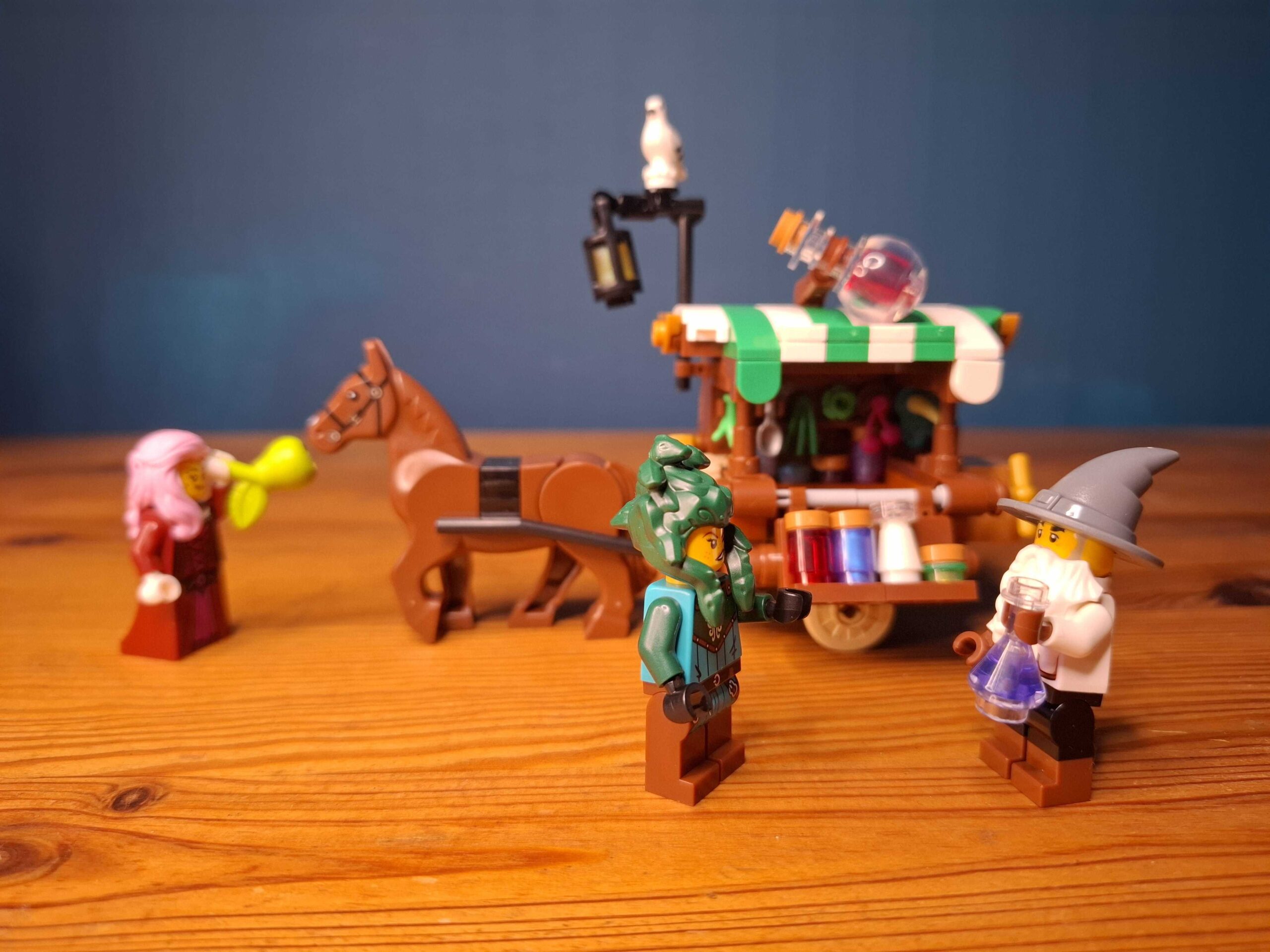
TBB: The herbalist cart is such a fun little build – I love the crank to flip it open, and the bottle on top that mirrors the shop (good branding, Alchemist!). Was it always a plan to include the vendor cart or was that a later idea for the project?
SW: Funnily enough, I already had a similar cart designed before I started work on the building, so it’s technically the first part of the model! It was based on a merchant’s cart from The Witcher 3 game. Only later did I decide to add it to the Alchemist’s Shop, modifying it to hold potions, but it was an easy inclusion.
TBB: Having gone through the process of seeing your concept make it to production, what have you learned about yourself as a builder? Has the journey changed your relationship to LEGO?
SW: That’s a great question. I believe I’ve grown more confident as a builder, but I’m also even more aware of how much more there is to learn! There are certain parts I gravitate towards and others I avoid, but I want to familiarize myself with all of them to choose them in the right situations. This journey has brought me to a place that I never thought I’d be. To be personally recognized by LEGO feels unbelievable, and I’m still fanboying over the fact that I have an official LEGO piece with my name printed on it (from the BDP trophy)!
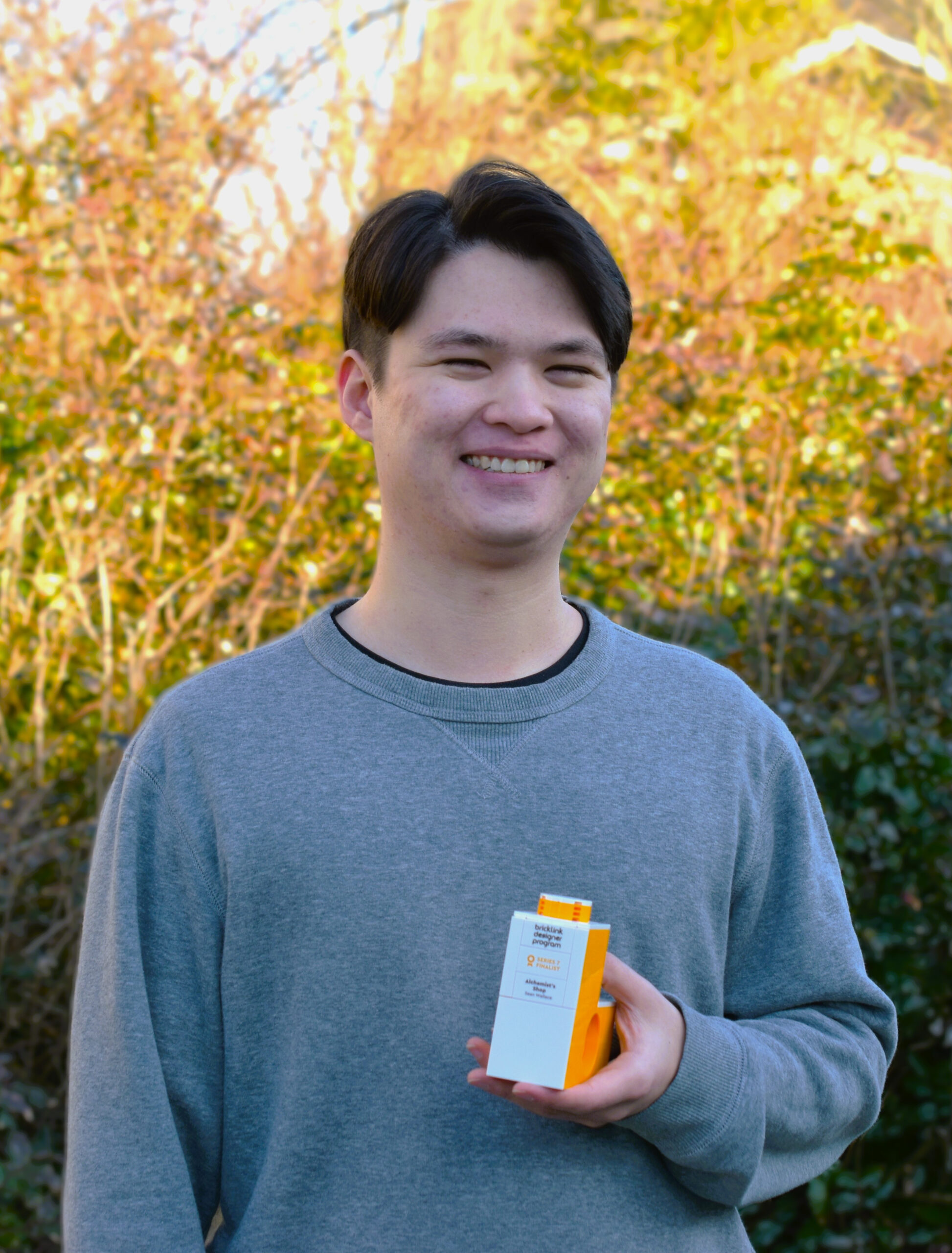
TBB: Do you plan to continue submitting ideas through the BLDP?
SW: Absolutely, it’s been so much fun. I really enjoyed the challenge and I think there’s still a lot I can improve upon. I have another one coming in BDP series 10 that I’m excited to reveal!
TBB: Do you have any advice for moc creators who are curious about participating with the BLDP? What does it take to succeed in the program?
SW: Research and planning are key. Before starting on this model, the first thing I did was grab plenty of reference images to get a sense of what I’d be going for. Sketch out your design, and think about the functionality of the set. How does it open, and where will minifigures be placed on the model? The tricky thing about LEGO as an artistic medium is that the set looking nice is only one dimension of the challenge. You also have to consider how sturdy it is, how playable it is, and how fun it is to build.
TBB: Thank you so much for your time, and best of success during the crowdfunding period, I’m sure the set will find many fans. It’s a joy to build and a wonder to behold.
SW: Thank you for reaching out to me! It was a pleasure to share my many thoughts about this set and my experience.
The post BLDP Series 7: Alchemist’s Shop – Set designer Sean Wallace makes magic [Interview] appeared first on The Brothers Brick.
Leave a Reply