The Douglas DC-3 is the cornerstone of what became the modern airline industry. When it was introduced in 1935, it was the first aircraft to provide profitable passenger service without relying on mail to subsidize operations. While unpressurized, it offered a higher level of comfort than earlier aircraft and could make the trip from New York to Los Angeles in just 18 hours with only three fuel stops.
Prior to the DC-3, a coast-to-coast “flight” could take more than 25 hours, involve multiple airlines, and require as many as 15 stops along the way. By 1939, an astonishing 90% of all airline flights worldwide were operated by DC-3s, and remarkably, many are still flying today.
But we are here to talk about LEGO too. As you might have guessed, LEGO’s new DC-3 set is a fantastic, large, and eye-catching model of an aircraft that played a pivotal role in aviation history, and it’s an easy recommendation for both AvGeeks and AFOLs alike. So today, we’re going to take a closer look at LEGO Icons 11378 Douglas DC-3 PAN AM Airliner, explore the history behind it, and see how it measures up with a visit alongside the real thing.
Flying in Style
Air travel in the 1930s was very different from today. A coast-to-coast flight across the United States was an ordeal by modern standards, both in time and cost. A ticket could run around $300 at the time, which is roughly $7,000 in 2026 dollars, compared to about $200 for a typical round-trip fare today (close to the $220 cost for this set). Flight times were long, routes were indirect, and the experience itself demanded patience.
Unpressurized cabins limited aircraft to altitudes of around 10,000 feet (3 km), as anything higher required supplemental oxygen or pressurization to remain safe. This meant pilots couldn’t simply fly above bad weather as they often do today. Combined with the lack of onboard weather radar, storms were often uncomfortable and unavoidable.
However, once onboard, passengers were treated remarkably well. Airline food was something to look forward to, with meals like steaks, cocktails, and even pancakes served in flight for breakfast. (Our sense of taste and smell changes at altitude, so modern airline food’s reputation isn’t entirely the airline’s fault.) Some aircraft even featured sleeper configurations with beds for overnight travel, reinforcing the idea that the journey itself was part of the experience.
Early flight attendants were registered nurses, hired both to reassure passengers about the safety of flying and to assist in case of emergencies. Their uniforms reflected that role, and you can still see hints of that influence in the 1958-era outfit worn by one of the minifigures included in the set. At the time, the adventure of flying was just as important as reaching the destination. In 1940, only about 2 million Americans—roughly 1.5% of the population—had flown on an airliner, making it a rare and memorable experience.
If you’d like to explore this era further, here are some excellent resources from Smithsonian Magazine and Air & Space Magazine that dive deeper into the DC-3 and the golden age of air travel:
How the DC-3 Revolutionized Air Travel
The Golden Age of Flight Attendants
More Than an Airliner
Early in the instructions for 11378 Douglas DC-3, the historical blurb states that 455 DC-3s were built for commercial use. That number likely refers only to early civilian production, as it doesn’t reflect the aircraft’s full production history. In reality, the DC-3 existed under several designations, including the military C-47, the Soviet-built Lisunov Li-2, and the Japanese Showa/Nakajima L2D.
Entering service just before World War II, the aircraft quickly became a cornerstone of military logistics. The U.S. Army Air Corps—before the U.S. Air Force was established as a separate branch—procured large numbers for the war effort. Meanwhile, licensed production in the Soviet Union and Japan meant the same fundamental aircraft design was used on multiple sides of the conflict, giving the DC-3 the unusual distinction of serving in opposing forces during World War II and continuing into the early Cold War era.
In total, 10,655 aircraft were built in the United States, along with 4,937 in the USSR and 487 in Japan, for a remarkable total of 16,076 aircraft. Few designs have seen that level of global adoption or long-term impact.
AC-47 Spooky Gunship at EAA Airventure (Oshkosh WI) 2002. Cockpit Photo has a DC-3 with a turboprop conversion in the picture as well.
Following World War II, a surplus of military C-47s was converted back into civilian DC-3s, flooding the commercial market. However, as is often the case, wartime innovation accelerated the development of newer, more advanced aircraft. By the 1970s, regional jets had largely replaced the DC-3 in commercial service, pushing it into shorter routes and more specialized roles.
Even so, the story doesn’t end there. Many DC-3s are still flying today, maintained by organizations like the Commemorative Air Force, which operates four C-47 variants (1 2 3 4) and one AC-47, and the Flagship Detroit Foundation, which keeps a beautifully restored DC-3 flying as an example of American Airlines livery. With the 2026 airshow season taking shape, there’s a good chance you might be able to see one in person soon!
A Trip to the Museum
C-47 at The National Museum of Transportation.
As impressive as it is to see a DC-3 in the air, getting up close at an airshow isn’t always possible—and not everyone has an airshow nearby. Fortunately, many museums around the world have DC-3s or C-47s in their collections. A quick search for “DC-3 museum” or “C-47 museum” will turn up options across North America, Europe, and beyond. Given how many were built and their importance to aviation history, there’s a good chance one isn’t too far away.
As it turns out, there’s one near me: The National Museum of Transportation (TNMOT). Known to many locals (especially kids) as the “Train Museum,” it’s located in the St. Louis suburbs, southwest of the city. While locomotives and rolling stock are the main attraction as you might have guessed, the museum also features a collection of automobiles, a boat, and a handful of aircraft—including a C-47.
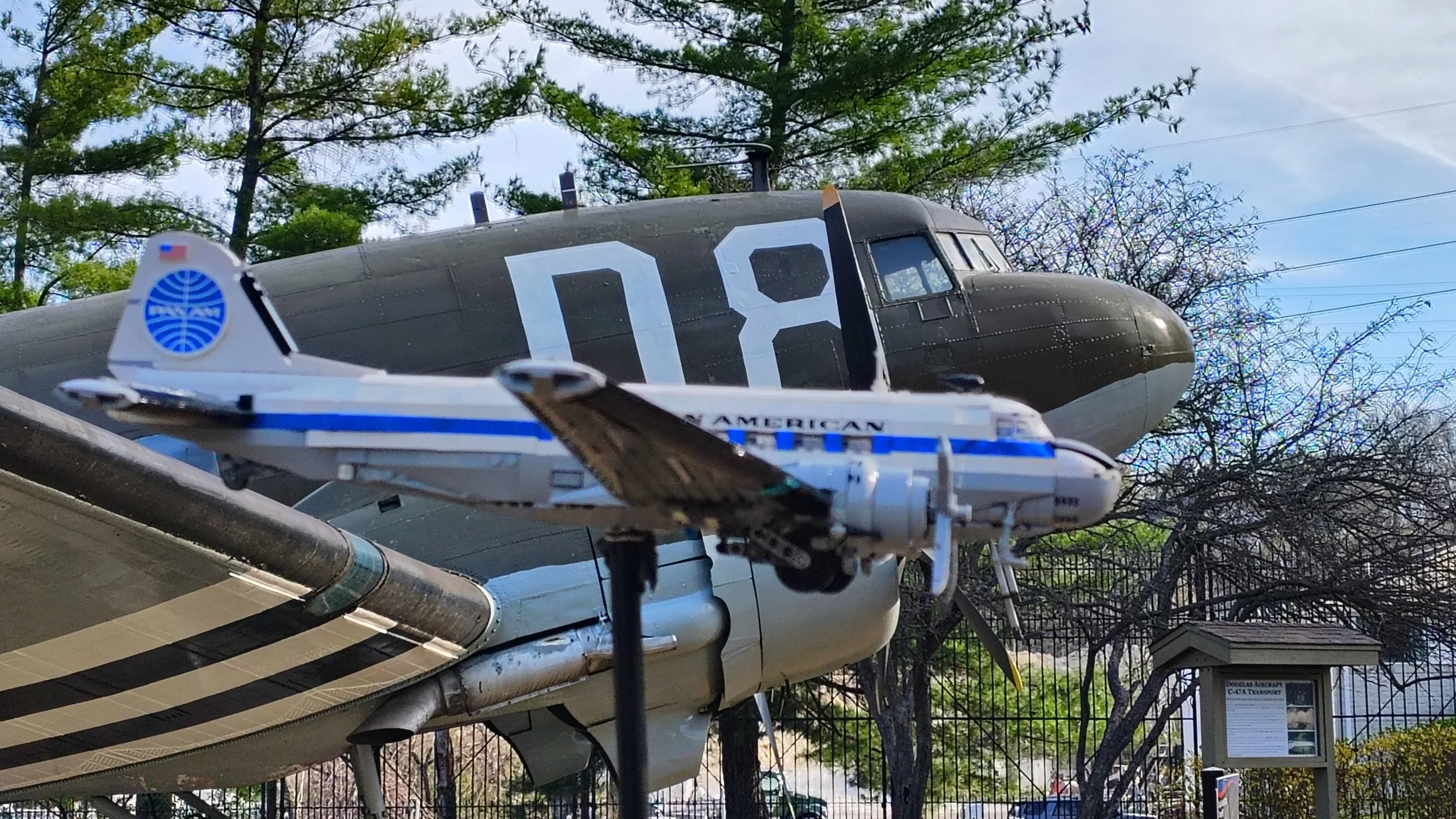
Front view: Since a 2×2 tile is about 0.375 inches, the model mounts nicely on a 3/8-inch dowel rod. The one I used doubles as a stand for airbrushing model rockets, which explains the extra color in some of the photos.
This particular aircraft, USAAF #N 3-15635—nicknamed the “Gooney Bird”—sits at the museum’s south gate and proudly wears D-Day invasion stripes. (Those black-and-white markings on the wings and fuselage feel like classic space yellow and black stripes.) The museum had long suspected this aircraft participated in D-Day, and that history has been confirmed in the last few years.
Door Details and invasion stripes.
After World War II, the aircraft entered commercial service in Nevada before being acquired by the Missouri Air National Guard’s 131st Fighter Group, where it remained in service until 1972. I reached out to TNMOT ahead of my visit, and Curator Coby Ellison generously allowed me to photograph the LEGO model alongside the real C-47 aircraft—and even get up close for reference.
I spent a few wonderful hours capturing photos of the two planes together, along with a few shots alongside some of the DC-3’s automotive and locomotive contemporaries. It was a rare opportunity to connect the model to its real-world counterpart in a meaningful way.
Even if aviation isn’t your primary interest, it’s worth seeking out and supporting local museums—especially smaller ones like this. They preserve incredible pieces of history and make experiences like this possible—amazing work!
Pictures from around TNMOT with the DC-3.
Thoughts on Branding
Even the casual observer will notice Pan Am and Douglas DC-3 branding on the box, but also spot the prominently displayed Boeing logo. (I mean, take a look at the real name with all the trademarks included: LEGO® Icons 11378 Douglas™ DC-3™ PAN AM® Airliner.) At first glance, that might feel a bit odd, but it’s actually a reflection of how much the aerospace industry has consolidated over time.
Donald Douglas founded the Douglas Aircraft Corporation in 1921, and the company went on to produce a wide range of civilian and military aircraft. Its Douglas Commercial (DC) line of airliners—DC-1 through DC-10—became its defining legacy. In 1967, after a period of financial difficulties, Douglas merged with the primarily military-focused McDonnell Aircraft Company. Over time, the DC line shifted into “MD” designations under McDonnell Douglas. Then, about 30 years later, Boeing merged with McDonnell Douglas and kept the Boeing name.
Two old birds enjoying the morning sun together!
That lineage still shows up today. The final DC-derived aircraft, the Boeing 717, was produced in 2005 and traces its roots back to the DC-9, first introduced in 1965. And since DC-3s are still flying, it’s a little surreal that information about their operation can still be found on Boeing’s website.
View fullsize
View fullsize
View fullsize
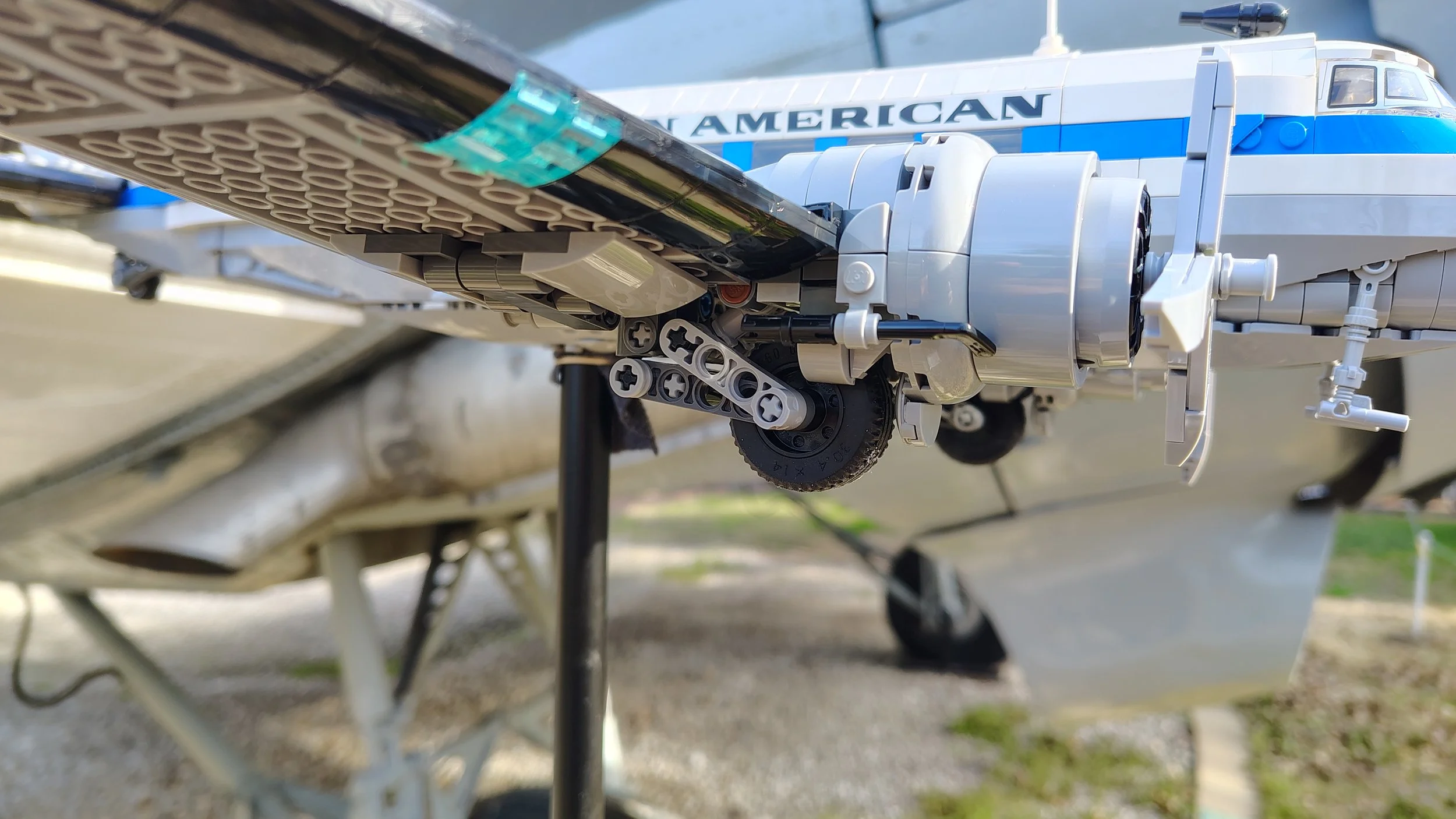
Hockey stick exhaust and landing lights on the wings look pretty good in LEGO form!
Pan Am operated from 1927 to 1991 and is still remembered as the glamorous, almost aspirational way to travel internationally. That vibe comes through nicely in the minifigures included in the set. For me, the Pan Am name immediately brings to mind Clipper flying boats and the early days of the “Jet Set,” with Boeing 707s and later 747s redefining long-distance travel. Pan Am operated 90 DC-3s between 1937 and 1966.
While it’s a recognizable airline and a solid choice for the set, the Pan Am livery is a little on the bland side—especially considering the DC-3 only wore the paint scheme toward the end of its service with the airline.
DC-3 and a General Motors #103 Diesel-Electric demonstrator locomotive, in a classy yellow and black paint! built in 1939 at TNMOT
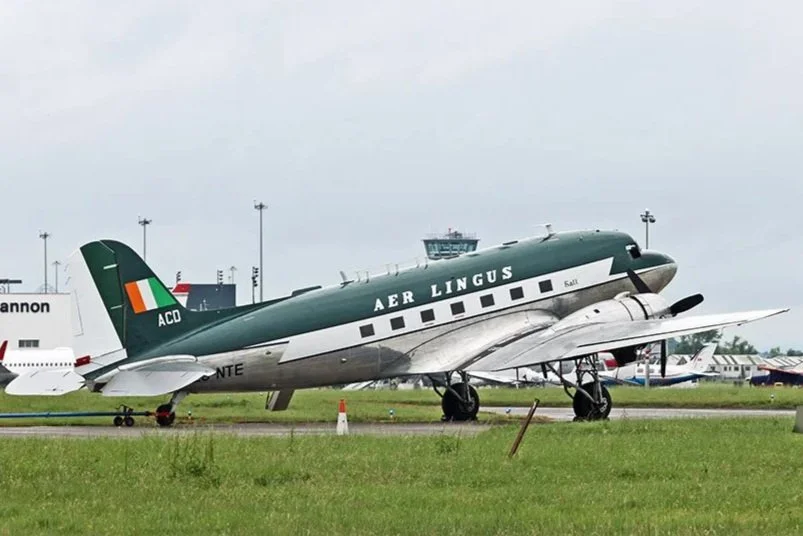
To be fair, liveries from that era weren’t nearly as bold as what we see today (take a look at some of Southwest Airlines’ special liveries). Most aircraft were finished in polished aluminum with minimal color, usually simple stripes. Color photos can be hard to track down (and you’ll end up digging through a lot of flight sim skins along the way), but there are a few standouts. Aer Lingus’ aluminum, white, and green scheme, Icelandair’s white, yellow, and blue, and KLM’s striking orange and black “Neutrality” colors all feel more visually distinct.
View fullsize
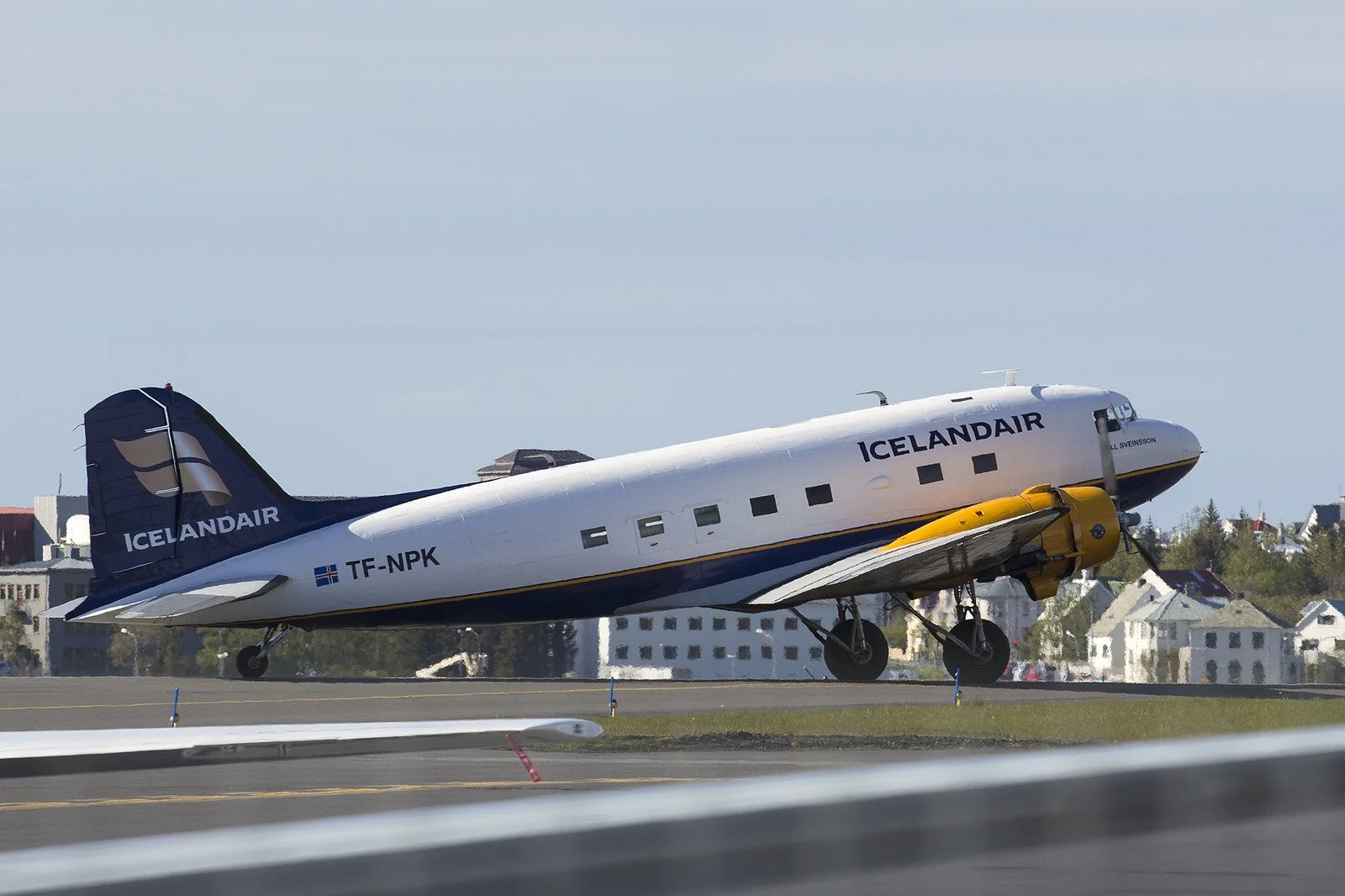
View fullsize
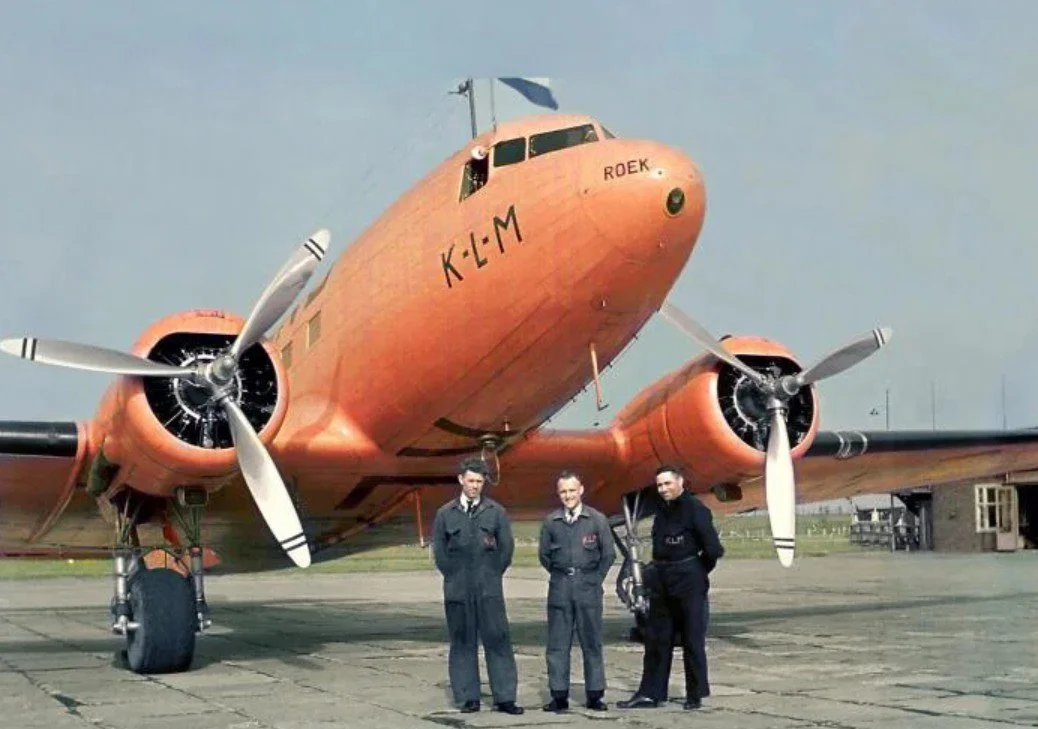
View fullsize
So Pan Am isn’t a bad choice—I just can’t help but notice that all three LEGO Icons aircraft lean toward very similar color palettes. 10318 Concorde sticks with white, red, and blue, and 10360 Shuttle Carrier Aircraft adds white, blue, black, and grey. A bolder color choice on the DC-3 could have made a shelf with all three feel a bit more dynamic.
Everyone is a Critic
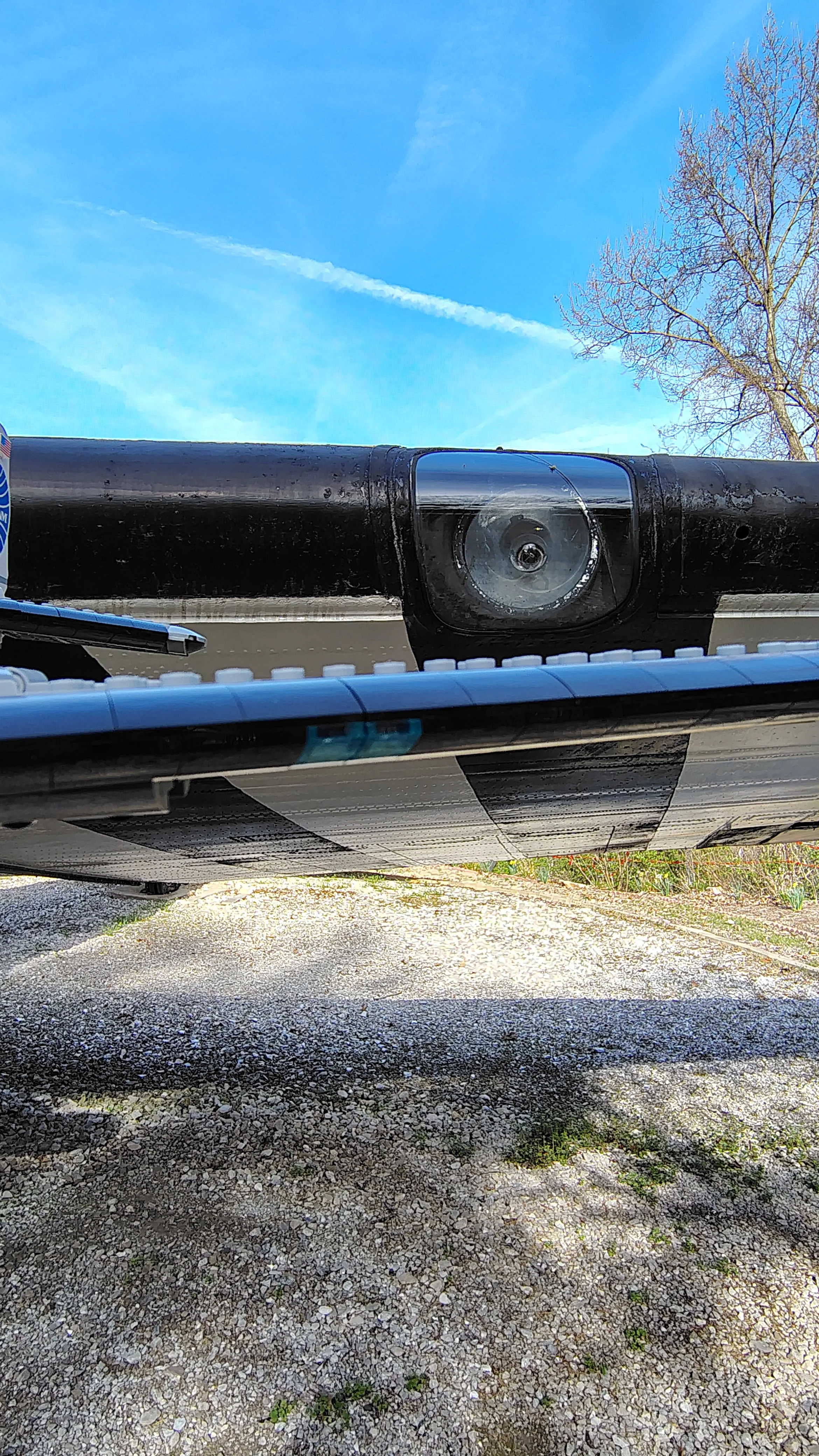
Depending on your level of aviation geekery, the set does have a few flaws. While the wing is closer to a true airfoil shape than what we saw on the Concorde or Shuttle Carrier Aircraft, the shaping still feels a bit off.
Adding just a plate of thickness could have given the wing a more rounded leading edge and a more accurate airfoil profile. It also might have allowed the landing gear mechanism to be tucked into the wing, cleaning up the somewhat messy underside. That said, I can see the tradeoff—the wing taper could have looked rougher with that extra thickness.
DC-3 Root airfoil in BLUE, LEGO DC-3 Root wing section in black
LEGO Icons aircraft are clearly designed as display sets, which is perfectly fine. Even so, despite its large wingspan, the DC-3 is delightfully swooshable. Functionally, though, the set is fairly simple, with spinning propellers and landing gear that aren’t as mechanically satisfying as what we saw in the Concorde or Shuttle Carrier Aircraft.
Part of that comes down to the real aircraft. The DC-3 had much simpler control surfaces than those later jets. On the model, these are represented by the dark gray sections on the wings and horizontal stabilizer—flaperons on the wings (a combination of flaps and ailerons) and elevators on the stabilizer. The rudder, however, isn’t represented, as it’s blocked by the large 6×6 Pan Am logo tile on the tail.
A little privacy please!
There are a few smaller details worth calling out as well. The interior includes an excellent little bathroom but it doesn’t have a door! And while the instructions reference a color illustration of the DC-3 interior from the Boeing archives (page 70), it’s a little disappointing that this image wasn’t included alongside the other historical materials at the beginning of the booklet.
Cleared for Takeoff!
Despite a few quibbles, I stand by what I said at the beginning: this is a truly stunning set. At 1:38 scale, the lines of the DC-3 are captured beautifully, with plenty of thoughtful details throughout. The Pan Am aircrew adds a fun historical touch, and I’m sure they’ll find their way into plenty of aviation MOCs.
While there’s nothing groundbreaking from a techniques standpoint, the shaping is well executed, especially along the leading edge of the wings, where newer elements are used to match the sweep nicely. The use of battle droid bodies for the pilot and copilot seats is a fantastic bit of part usage. With this now marking the third Icons aircraft—alongside builds like 10363 Leonardo da Vinci’s Flying Machine—it feels like LEGO is building out a proper aviation subtheme.
Looking back, this legacy includes two Sopwith Camels, Fokker DR-1 (Red Baron), 787, and the Wright Flyer sets from the early 2000s.
Unfortunately, many advances in aviation have come through military development, so it’s unlikely we’ll see much beyond the two World War I aircraft already represented in that space. That said, there’s still plenty of room to explore. A Piper J3 Cub, Beechcraft V-tailed Bonanza, Rutan Long-EZ, Lockheed Constellation, Spruce Goose, or another classic flying boat would all feel right at home in the LEGO Icons line.
Even something like the Bell X-1 might be a stretch due to its USAF connections, and the X-29 still looks like the future 40 years later! The AN-2, JU-52 (both with a mix of civilian and military history) would also be neat additions. And with key anniversaries on the horizon—the Spirit of St. Louis approaching its 100th next year and the Wright Flyer nearing its 125th in 2028—either would make a fitting addition.
Sets like 11378 Douglas DC-3 show just how well LEGO can capture aviation history at this scale, and hopefully it’s just the beginning, because there’s a long runway of possibilities ahead for AFOL AviGeeks.
LEGO Icons 11378 Douglas DC-3 PAN AM Airliner is available for around $220 US | $300 CA | €220 EU | £200 UK | $380 AU.
DISCLAIMER: This set was provided to BrickNerd by LEGO. Any opinions expressed in this article are those of the author.
What aircraft would you want to see next in the LEGO Icons lineup? Let us know in the comments below.
Do you want to help BrickNerd continue publishing articles like this one? Become a top patron like Paige Mueller, Rob Klingberg from Brickstuff, John & Joshua Hanlon from Beyond the Brick, Megan Lum, Andy Price, Lukas Kurth from StoneWars, Wayne Tyler, Dan Church, and Roxanne Baxter to show your support, get early access, exclusive swag and more.
Leave a Reply